Saturday, March 31, 2007

Sounds Like Chicken: ...Like A Cannonball To The Ocean Floor


The title and cover of Sounds Like Chicken’s one and only full-length recording brings to mind an album filled to the brim with blood and cutlasses, loot and scurvy. In fact, beyond the titles and a few tracks, the pirate theme turns out to be more of a jumping-off point than a full-blown concept, which works better. A seven-piece ska band from Melbourne, SLC did a decent job of capturing the energy of their live shows on this release. ‘Walk Ye The Plank’ kicks things off right, a lurching beast of a tune punctuated by a barking chorus of ‘Hey! Ho!’, which, even though it’s been used dozens of times, doesn’t seem tired here. From there, the album stumbles a little - ‘The Battle of Stentorian’ aspires to be epic, but isn’t entirely convincing. But then ‘Global Domination’ saunters in with its tight rhythms, rumbling vocals and loud guitar, and the SLC banner again flies high. ‘A battle cry from the rebel elite’ may sound like something of an oxymoron, but its sentiment is perfect for a bunch of rowdy young males. ‘Entrails’ takes aim at B-grade actors and watchers of current affairs programs, both of which, in terms of being objects of denigration, are only slightly harder targets than Michael Jackson. ‘Scourge of the Black Spot’, an intentionally shanty-like tune, is one of several tracks that revolves around dodgy in-jokes, in this case the mythical Captain Borange (guess what that rhymes with). Nevertheless, these bits of nonsense do add a bit of colour and range to the album: a good example is the hapless student asking for ‘Piano Lessons’, which leads into the building groove and eventual outburst of ‘The Awakening Pt 2’. The instrumental ‘The Payoff’ initially seems like a breather amidst all the blood and butchery, but turns out to be the best track of the lot. It combines a chilled-out rhythm with a ripping saxophone solo, moving beyond the borders of ska into the realms of reggae and jazz. ‘Spilt Beers and Drunken Tears’ rolls in like the fag-end of a drunken night that’s devolved into crap but which you still wouldn’t trade away. The slightly rough, unbroken chorus is a highlight. ‘The Ballad of William Stout’ is another slice of gibberish, while the closer, ‘Take A Bullet To The Grave’, ends the album on a suitably furious note. Like the rotting skull on its cover, ‘Like A Cannonball…’ almost seems like the id set loose, but it’s generally reined in before the throat’s bled dry. All in all, it’s a fun package – as goofy as the band’s moniker, and as sharp as the knife of the filthiest brigand.

Wednesday, March 21, 2007

Wool and Water

Meg sits knitting, anxiously slipping off the stitches, through the height of the afternoon. The cool sea breeze enters the room and lightly disturbs the smooth flaps of her cotton dress. A sign of strong seafaring weather, says her aunt wistfully, sewing with her three attractive cousins (less wistful than capricious and haughty) at the long wooden bench. Hopefully it means a fine homeward gale for our own distant sailors. Meg gives her a smile. Like the wily warrior, he would one day return. But for now there is a huge school order to fill, and she doesn’t know if it will be finished by the following Monday. The needle guides her tingling hand, over and under, and along the tossing threads of blue wool, forming a pattern that loops, that shimmers…
Waves lap, under the ache of the caustic sun. Then the rummy haze and the stars like moss-covered silver. To follow the crack of gunfire and to bathe in a pool of blood and salt, and after all is done, will he return to port with them, perched upon the spar, or will they skin his worthless bones? He is resting in the cabin, below deck, when John Black bursts in to tell him that a coastal town has been sighted to the west. His only reply is to look at the wall, to the east. The mate, in jest, punches him on the shoulder, ‘Cairn’t ye show yuir face for once, ye Ol’ Grey Dog?’ They call him that though he is neither old nor grey. Eventually, Black leaves and he returns again to dividing up the loot. Then, having completed his task, he lies down, curled upon his hammock, and closes his blistered eyelids. He does not lie down on shore again for forty more years.

She spies him at the base of the pier, hunched over, smelling the mackerel.
‘Beautiful morning, isn’t it?’ she calls to him.
He looks up, and takes the hook out from between his teeth. ‘Why Meg, m’lady, it’s abs’lootly balmy. Lord don’ make it better for me, nay?’
The net hangs loosely over the bow. ‘You’re a fisherman now, then?’
‘Bin cast by dis here ocean too darn’d long. Nee’d to set down, ye kno’. Nee’d to claim it f’me own.’ She looks into his old grey eyes. ‘So howz ye’ve bin, Meg?’
‘Business is well. My niece is running most of the day-to-day stuff now.’
‘Goo’. Goo’. Tha’s be cheery news.’ He walks halfway across the pier, and then turns around.
‘Come inside, m’lady, m’dame, m’maharanee.’

At ten-thirty sharp each day, he mops the cedar-wood floor and scrubs off the salt that seeps from the chimney bricks. He shaves the carp, and wraps them in blankets. Always the fisherman, he wears his waterproof coat and galoshes indoors as he potters around the cupboards making coffee for her, Chinese tea for himself. He coughs up saliva constantly. He lights three candles, and places them all in the centre of the round table at which she sits. Then he sits down opposite her, and rubs his grey beard red, twisting and twirling the long thick hairs with his fingers, and all the while he is saying,

‘I men t’ come ho’, Meg. Men t’ come ho’.’

An albatross, Ishmael’s bane, flies boldly out to sea. I leave him, and walk barefoot across the waterlogged sand. Even now, the sky and ocean meet in a calm turquoise. But what is this thing that lures men away, following the strip of red-gold, and brings them back as cloaked beggars?
There is a memory that I did not tell him about, that I do not have. I stand outside each night, wrapped in my blue woollen cardigan, and trace a crooked path from my waist up to my chin. When I look up, I see him floating into shore, nestled lightly on a sailboat hewn from a falling star. I walk out to him, and he smothers me, in pearls, in spices, before finally, drenched in essence, we drift together until daylight comes. Drift until the moment I turn over to find him gone, departed, a glint upon the waves.

Sunday, February 4, 2007

Avengers Assemble!: A Pseudo-Critical History of The Avengers - Part II

A Climatic Culmination of Cooperative Creativity!

Roy Thomas replaced Stan Lee as writer with issue #35, and would chronicle The Avengers for the next seventy issues. He was joined by artist John Buscema for around half of those issues, with Don Heck, Sal Buscema, Barry Smith and Neal Adams (among others) also lending a hand. Although Lee and Kirby were the team that created the Avengers, from around the 50s onwards Thomas and Buscema would produce what was arguably the definitive run of Avengers comics. More literate than Lee and more classical than Kirby, Thomas and Buscema created a world for the Avengers that drew heavily upon both science fiction and mythology, but which was still realistic enough to make you believe that the Avengers actually live in a mansion in the center of New York.[6] Subsequent creative teams would each attempt to capture the epic scope of the Thomas/Buscema tales, while keeping the Avengers grounded in the city that surrounds them.

Thomas, for one, was evidently keen to mix things up for his heroes. He had the Avengers travel through time and to alternate universes, sent them into space to stop interstellar conflicts, storm the halls of Olympus, home of the Greek gods, and fight giant demons made out of fire and ice. But he also had the Avengers head to the mountains to avenge a tribe of Native Americans, protect the streets from the dangers of racist hate-groups, and hire themselves out as demolition workers to a greedy tycoon. Notably, Thomas tightened up the relationships between the main cast members, with Yellowjacket (formerly Goliath) marrying the Wasp, Goliath (formerly Hawkeye) revealing his true identity to his teammates, albeit obliquely, and the Vision and the Scarlet Witch gradually falling in love. Most of the line-up either lived in or spent the majority of their time hanging around the Mansion, while solo adventurers Thor, Iron Man and Captain America were reserved for guest appearances.

Buscema’s art, meanwhile, reflected this blend between the everyday and the extraordinary. When a long-haired, muscle-bound warlord stumbles into the room and proclaims himself Arkon the Magnificent, you believe it. Conversely, Buscema also makes it seem perfectly natural for a police officer to threaten a ten foot hero with arrest for blocking city traffic. Buscema’s artwork is a little darker in tone than that of most other Avengers artists; no-one walks when they can prowl, no-one talks when they can scream in anguish, and a lot of the members that appear during his run – the Vision, the Scarlet Witch, Quicksilver, the Black Panther and the Black Knight – aren’t exactly the most happy-go-lucky bunch of characters. One often gets the sense when reading through his stories that the Avengers’ world teeters on the edge of destruction. Nevertheless, Buscema’s art set the visual template for other artists to follow – strong figures, dynamic angles, and just the right amount of detail to set the scene for the action. Having said all that though, let’s start with an issue drawn by Buscema’s predecessor, Don Heck, to show how the world has become a much more disturbing place for Earth’s Mightiest Heroes.

Time, the Rushing River…

Although in The Avengers, readers are continuously confronted with the possibility that things may take a turn for the worse, at the end of the day, our heroes are still around to protect the world from those who would threaten it. By the time the next issue rolls around, most of the possible courses that events may have taken are shelved are forgotten, thus lending a seeming inevitability to the Avengers’ lives. In Avengers Annual #2, the current-day Avengers are confronted with an alternate history in which the original line-up, under the influence of the villainous Scarlet Centurion, have effectively taken over the world.[7] The Centurion has basically tricked the Avengers into neutralizing every being with superpowers, under the pretence that this will correct a ‘cosmic imbalance’ and enable the Centurion to create a paradise on Earth. The Avengers therefore believe that they are doing ‘good’ in following the Centurion’s instructions, but the results are almost as bad as if their worst foe had been left unchecked. All the heroes are defeated (even before the super villains), and the public stand in silent fear of anyone in a costume, as shown when the current-day line-up arrive on this world.[8] Clearly, despite the Avengers’ best intentions, something has gone horribly wrong.


Or has it? Maybe it’s the case that one’s intentions are defined by one’s actions. ‘She’s snarling out her words so venomously… with such strong hatred!’ notes the Wasp as she fights against her alternate self, ‘years of self appointed world-saving have made her as cruel as the worst super-villain!’ (Annual #2) Or perhaps one’s intentions are irrelevant, as long as the results of one’s actions are for the best. ‘Are we certain we have the right to oppose them… merely to safeguard our own existence?’ the current-day team wonders, ‘If we were guilty of robbing the earth of a virtual golden age..!’ Captain America convinces them otherwise, ‘Mankind has often tried to escape from freedom… into the open arms of tyranny! Over the long haul, the result’s always been the same…’ These Avengers will fight to stop any dictatorship, benign or otherwise.

‘Time is like a river,’ says the Black Panther, ‘Dam it up at any one point… and it has no choice but to flow elsewhere… along other, easier routes!’ While it may seem, in hindsight, that history is following its natural course, any other course would seem just as natural had it occurred. When the new Avengers have left the Mansion and we check in on what the original Avengers are doing, it’s as if we’ve been following these characters for the past five years, and the new Avengers are the interlopers. Where the two teams fundamentally differ is in their attitude to history. The ‘old’ Avengers are aiming to shape history, as shown when they ban all scientific inquiry ‘lest any other mortal gain super-powers’ (as is wont to happen in the Marvel Universe). The ‘new’ Avengers, on the other hand, are willing to take their chances. They would be content to let this new timeline stand, if only it meant that mankind had freedom of choice. The ‘new’ Avengers are not dictators but facilitators: they believe that if you let history take whatever course it will things will generally work out for the best, but they’re still ready to help out if things should go wrong.


Further adventures through the looking-glass take place in issues #69-70, when the Avengers face off against the Squadron Sinister, a group of super-villains that bear more than a passing resemblance to DC Comics’ premier super-team, the Justice League of America.[9] Once again heroes become villains, although the Squadron’s first appearance may be more a case of cross-company rivalry than anything else. However, the Avengers’ next encounter with the Squadron turns everything back on its head. Our heroes have returned from Arkon’s dimension only to find that they are the last witnesses to a ‘doomed and burning earth’ (#85). It turns out that they have traveled two weeks into the future, but with the help of the Scarlet Witch’s hex-power, manage to return back to their own time. Or so it seems – when they enter their meeting-room they find it occupied by Nighthawk of the Squadron Sinister and four other strangers who claim that they are the intruders. Yes, the Avengers are once again trapped in a parallel world, but on this world the Squadron Sinister are not villains at all, instead, they are Earth’s mightiest heroes - the Squadron Supreme. One couldn’t blame the Avengers for wanting to go sit in a corner and hope that they wake up, but they are intent on saving this world from destruction. The obvious reason for doing so is that they are trapped on this world, so that if it dies, they die too. But, in another sense, whatever world the Avengers happen to be on is their own. The Avengers are eventually returned safe and sound to what seems to be their original home, but the Vision is not so easily reassured. ‘There may be paradoxes within paradoxes…’ he says to Quicksilver, ‘How can we be certain that we have not been rescued by a third world – all but identical to our own?’ (#86) Don’t judge a place lest ye be judged – you may be in for a longer stay than you think.

Whose Side Are You On, Baby?

When the Native American hero, the Red Wolf, tells how his parents have been killed for refusing to sell their land, some of the Avengers think that while his cause is just, it pales beside the menace of the Zodiac Cartel. Captain America thinks that one shouldn’t be so quick to make this judgment. ‘We run around calling ourselves Avengers --,’ he tells his teammates, ‘yet when this man comes before us with something to avenge… we turn a deaf ear – because his cause isn’t world-shattering enough for us! We forget that the world can end with a whimper – as well as a bang!’ (#80) As the Avengers entered the 1970s, they would increasingly realise that evil need not come with super-powers. Angry mobs and organized crime are potentially just as dangerous to the well-being of society as the plans of ‘costumed madmen’.

One of the main themes of Thomas’ run is how one spark of hatred can quickly lead to mass hysteria. In issues #73-74, a group known as the Sons of the Serpent blow up the Equal Employment Bureau and target high-profile African-American figures such as television presenter Montague Hale, singer Monica Lynne, and Avenger and King of the Wakandians the Black Panther. The incidents ignite a fiery on-air debate, led by Hale and bigoted late-night host Dan Dunn that threatens to divide America along racial lines. Similarly, in issue #92, a politician named H. Warren Craddock leads a witch-hunt against the Avengers’ ally, the alien Captain Marvel (essentially xenophobia on a cosmic scale), which results in a group of rioters tearing up the Avengers’ mansion. Most insidious of all though is the violence stirred up in #98 by the mysterious Mr. Tallon, who in moments transforms a ‘curious crowd’ into a bunch of ‘frenzied revolutionaries’. The objects of their war-mongering are ostensibly the representatives of an (unnamed) Asian communist nation, but the crowd quickly turns into a chaotic mass of pure hatred that doesn’t care who or what it engulfs. Mr. Tallon’s power derives not from his arguments, but from a hymn of martial pipe music that fills anyone who hears it with the desire to ‘smash America’s foes’ (#98). Hence, when Captain America and the Avengers turn up to try and reason with the crowd, all of their ideas of peace and brotherhood soon fly out the window. ‘Let’s go tear up those Commies!’ (#98) shouts a rabid Captain amidst the storm, and the dark side of national pride is shown in all its horror.


In all of these cases, however, those who incite the intolerance turn out to have another agenda entirely. The Supreme Serpents are eventually revealed to be the bickering TV personalities Dunn and Hale, who put on their ‘racist act’ for the sole reason that everyone would be watching. ‘Did you truly think we cared for anyone – any cause,’ Hale asks the Avengers, ‘except power for ourselves?’ Similarly, the real H. Warren Craddock turns out to have been replaced by a shape-changing Skrull, and Mr. Tallon is actually Ares, Greek god of war, who is stirring up trouble as part of his plot to crush the Earth forevermore.[10] There are at least two views that one could take on this tendency for racial prejudice to be revealed as nothing more than a super-villian’s grab for power. On one hand, it could be seen to trivialize racism by attributing its cause to ‘costumed madmen’ rather than to particular social and political factors. However, another argument that I have seen advanced is that it demonstrates how baseless racism really is. This seems plausible enough, although continually disguising the identity of the perpetrators does seem like a choice that has been made mostly for dramatic effect.

Whatever explanation you hold to, it’s hard to see exactly what the Avengers are fighting for or against here. Hale speaks to Monica Lynne of ‘the cause’, but his cause turns out to be nothing but a sham. Nevertheless, after Hale is exposed, both Monica and the Black Panther are convinced that they have gained a new purpose. ‘A cause may be right,’ says the Panther, ‘Even though a leader or two may be wrong.’ (#74) But who or what exactly is standing in the way of this cause? Super-villains? Gullible fools? Perhaps the answer is that there are no sides, but that each person must try to help others find the truth behind the lies that people tell. A teammate of the Panther’s, who has no ties to any race, religion or creed, would show just how arbitrary the distinctions the human race makes for itself can be.

Who Is The Vision?

As the Avengers assemble to decide whether or not to accept the Vision into their ranks, Goliath/Henry Pym tells their scarlet-faced ally that he is not really an android - but a synthozoid - who is ‘basically human in every way… except your body is made of synthetic parts!’ (#58) The Vision is not so sure, ‘I wonder… is it possible to be… “basically human”?’ he muses. Despite Hank’s encouragement, we often see the Vision doubt his status as a ‘human being’, and perhaps with good cause. He was created by the evil robot Ultron-5 to be nothing more than ‘an inhuman slave’, without a name or ‘soul’. When he first attacks the Wasp, she describes him as ‘some sort of unearthly, inhuman vision --,’ (#57), an apt description for the ghostly figure that swoops into her apartment, like a stalker from a B-grade horror flick. Except that any human stalker, when faced with a locked room, would have to try and bash the door down to get at the terrified girl; the Vision, on the other hand, simply has to lower his density and walk through the wall. Even after the Avengers have accepted the Vision as both a friend and a colleague, they still find it hard to get over how ‘unspeakably cold’ (#58) the android’s voice is.


On the other hand, the Vision certainly does show some human traits. For one thing, he has a tendency to question his own reason for being. It’s true that when he first encounters the Avengers, he seemingly has a limited capacity for independent thought - ‘There is nothing to reason about, human ---,‘ he says to Goliath, ‘I was sent to destroy you – and destroy you I must!’ (#57) But later, when he faces off against Ultron-5, different thoughts are upon his mind. ‘I have human thoughts… human memories!’ he says to his creator, ‘Why, Ultron-5? Who… or what… am I?’ (#57) Other signs that the Vision may be more human than first thought include the hatred he feels for his creator Ultron-5, and most famously, the tear he sheds when the Avengers finally accept him as one of their own.[11] It turns out that the Vision’s mind is based on the ‘brain patterns’ of the late Wonder Man, which the Avengers copied and Ultron stole from their lab. The Vision uses this to his advantage in issue #79, when he reveals to Wonder Man’s brother, the Grim Reaper, that he has the mind of his lost sibling, thus leading the Reaper to free the Avengers lest he condemn his brother to death. The Vision’s use of the Reaper’s fraternal ties suggests an understanding of human psychology that is beyond that of a mere machine.

However, does the fact that the Vision shows human traits qualify him to be a part of the human race? The Vision’s first betrayal of Ultron turns out to be part of his programming, and Ultron briefly re-gains control of the Vision in issues #66 and #67. These incidents raise some doubt about how much free will the Vision truly possesses. Furthermore, as the Vision notes, the robotic Ultron is just as prone to showing emotion as his progeny, as shown when he hurls himself at the Vision in rage, (temporarily) destroying himself in the process. After defeating the Reaper in issue #79, the Vision decides to leave the Avengers, claiming that ‘I am not his brother – nor am I a brother to any true human being!’ (#79) It may be that while the Vision understands Eric Williams’ emotions, he can not feel them in the same way that the Reaper does. However, the Vision’s exile from the human race does not last long – in issue #80 we see him posing as a streetwalker, complete with rubber mask. In that issue, he decides to help the Red Wolf bring the murderers of his family to justice. ‘I had [quit],’ he tells the Red Wolf, ‘for reasons of my own! Yet now I am back – for better reasons!’ (#80) It seems that the Vision has worked out that he is better off being a part of the human race than being apart from it. But what is the basis for his decision?

Perhaps a clue can be found by looking at the Vision’s closest tie to the human race - his burgeoning love for the Scarlet Witch. One of the first signs of the Vision’s affection for Wanda is when he surrenders himself to save her from a gang of armed hitmen. ‘Before now, I’ve always thought of him as cold… aloof,’ thinks the Scarlet Witch, ‘But I was wrong – so wrong!’ (#81) While it may seem that the Vision’s emotions often overcome his reason where Wanda is concerned, the line between the two is not always clear. When some of the Avengers, including the Scarlet Witch, are captured by a Skrull battalion, the Vision’s anger seemingly gets the better of him, as he bashes the Skrull commandant half-to-death in his efforts to learn where they have taken his lady love. Iron Man yells at him to stop, ‘You’ll kill him! You don’t know what you’re doing!’ (#96) The Vision corrects him, ‘My brain is a miniaturized, high-speed computer. I always know what I am doing. I—am—killing--him.’ Similarly, when the Olympians turn up to kidnap one-time Avenger Hercules, the Vision is too busy playing ‘nursemaid’ to Wanda to help, earning him the ire of Hawkeye of the process. The Vision is unperturbed, ‘I reject your line of reasoning,’ he tells the archer, ‘I help those I care for, Hawkeye, above all else!’ (#99) What the Vision realizes is that cold logic can only take you so far; once you begin to examine the reasons behind your actions, eventually you’ll come to something that has no foundation, no argument supporting it, but which is simply a matter of choice. And if that is the case, then why not follow what you feel is right, since that makes as much sense as anything else.

Covers copyright Marvel Comics

[6] Lee, however, has everyone beat for wordplay.
[7] It is later revealed that, through the vagaries of time travel, the Scarlet Centurion is actually an earlier version of Kang the Conqueror.
[8] Two other interesting points about this world: 1) of the original Avengers, it is the Hulk that is the least willing to follow the instructions of the Scarlet Centurion, and 2) once the Avengers have done their dirty work, the only super-beings who still oppose them are Doctor Doom, Doctor Octopus, Electro and the Mandarin.
[9] Superman is re-cast as Hyperion, last survivor of an alien world; Batman becomes the bored tycoon Nighthawk; Green Lantern appears as the prism-powered Doctor Spectrum; and the Flash morphs into the super-fast Whizzer (who like the Flash, also took his name from an old comic-book hero).
[10] And don’t forget the Valkyrie, leader of the short-lived feminist super-group the Lady Liberators (seen in issue #83), who turns out to be the Avengers’ old foe, the Enchantress.
[11] Note that, in a sign of their trust in the Vision, the Avengers are all unmasked when they induct him into their ranks.

Monday, January 29, 2007

The 100 Greatest Albums Ever

Music fans will be quite familiar with the concept of the ‘all-time greatest album’ list. Many of these types of lists surfaced around the turn of the century, although a few have appeared since that time (the most recent being Time Magazine’s All-TIME 100 Albums, which was released late last year). Such lists are usually accompanied by some justification for why the albums on the list were selected, citing factors such as musical influence, cultural influence, genre representation, and originality. The authors will also often stress how long they spent compiling the final list, noting with pride how they listened to hundreds upon hundreds of albums, and how they spent hours agonizing over which albums to include on the list, and which albums to consign to the dumpster.

These methods are all wrong. Any list of the 100 Greatest Albums should be able to be written in less than half an hour, depending on how fast you type. Having read dozens of ‘best of’ lists, I now swear by the following rules. If an album seems like it would be a strange inclusion on the list, it’s out. If an album seems like it would be a significant omission from the list, it’s in. If I have to think about an album for more than ten seconds, it’s out. If I have to look through my record collection or go through my bookshelf to remember that an album exists, it’s out.[1] These rules ensure that I don’t ho-hum, dilly-dally, or flip-flop about any album on the list (or at least, about ninety percent of them anyway).

Having said all that, I should add the following qualifications. I reserve the right to kick any album off the list if the weight of public opinion should turn against it. I do not consider the fact that I’ve never actually heard a particular album as a valid objection to its inclusion (how many people have read War and Peace or David Copperfield). I do not consider the fact that I will probably never listen to a particular album as a valid objection to its inclusion. This list is not written by me, but through me. It is the list that you know exists, but you may not want to admit it, because it shows how you like pretty much the same stuff as everybody else does.

With these considerations in mind, the 100 Greatest Albums are as follows:

Back In Black - AC/DC
The Band - The Band
Pet Sounds - The Beach Boys
Paul's Boutique - The Beastie Boys
Abbey Road - The Beatles
Revolver - The Beatles
Rubber Soul - The Beatles
Sgt. Pepper's Lonely Hearts Club Band - The Beatles
The Beatles - The Beatles
Odelay - Beck
Paranoid - Black Sabbath
Parallel Lines - Blondie
Parklife - Blur
Blonde On Blonde - Bob Dylan
Blood On The Tracks - Bob Dylan
Bringing It All Back Home - Bob Dylan
Highway 61 Revisited - Bob Dylan
Legend - Bob Marley
Born To Run - Bruce Springsteen
Trout Mask Replica - Captain Beefheart and His Magic Band
Tapestry - Carole King
London Calling - The Clash
The Clash - The Clash
A Rush of Blood to the Head - Coldplay
Hunky Dory - David Bowie
Low - David Bowie
The Rise and Fall of Ziggy Stardust - David Bowie
Three Feet High and Rising - De La Soul
The Doors - The Doors
Dusty In Memphis - Dusty Springfield
Hotel California - The Eagles
Goodbye Yellow Brick Road - Elton John
The Sun Sessions - Elvis Presley
The Marshall Mathers LP - Eminem
Rumours - Fleetwood Mac
Appetite For Destruction - Guns 'N' Roses
Live At The Apollo - James Brown
Grace - Jeff Buckley
Psychocandy - The Jesus and Mary Chain
Are Your Experienced - The Jimi Hendrix Experience
Electric Ladyland - The Jimi Hendrix Experience
A Love Supreme - John Coltrane
Plastic Ono Band - John Lennon
Blue - Joni Mitchell
Closer - Joy Division
Trans-Europe Express - Kraftwerk
Led Zeppelin II - Led Zeppelin
Led Zeppelin IV - Led Zeppelin
Physical Graffiti - Led Zeppelin
Transformer - Lou Reed
Forever Changes - Love
The Holy Bible - Manic Street Preachers
What's Going On - Marvin Gaye
Blue Lines - Massive Attack
Thriller - Michael Jackson
Kind of Blue - Miles Davis
After the Goldrush - Neil Young
Harvest - Neil Young
In Utero - Nirvana
Nevermind - Nirvana
Definitely Maybe - Oasis
What's the Story Morning Glory? - Oasis
Otis Blue - Otis Redding
Horses - Patti Smith
Graceland - Paul Simon
Ten - Pearl Jam
Dark Side of the Moon - Pink Floyd
The Wall - Pink Floyd
Doolittle - The Pixies
Stories From The City, Stories From The Sea - PJ Harvey
Dummy - Portishead
Screamadelica - Primal Scream
Sign O' The Times - Prince
It Takes a Nation of Million to Hold Us Back - Public Enemy
Different Class - Pulp
OK Computer - Radiohead
The Bends - Radiohead
Ramones - Ramones
Automatic For The People - REM
Beggars Banquet - The Rolling Stones
Exile On Main Street - The Rolling Stones
Let It Bleed - The Rolling Stones
Sticky Fingers - The Rolling Stones
Never Mind The Bollocks Here's The Sex Pistols - The Sex Pistols
Siamese Dream - The Smashing Pumpkins
The Queen Is Dead - The Smiths
Daydream Nation - Sonic Youth
Innervisions - Stevie Wonder
Songs In The Key Of Life - Stevie Wonder
The Stone Roses - The Stone Roses
Fun House - The Stooges
Is This It? - The Strokes
Marquee Moon - Television
Achtung Baby - U2
The Joshua Tree - U2
Astral Weeks - Van Morrison
The Velvet Underground and Nico - The Velvet Underground
Urban Hymns - The Verve
White Blood Cells - The White Stripes
Who's Next - The Who

[1] I owe a debt to ESPN writer Bill Simmons for these criteria, as he used a similar approach when suggesting what criteria should be used for inducting athletes into the various Halls of Fame.

Wednesday, January 10, 2007

Avengers Assemble!: A Pseudo-Critical History of The Avengers - Part I

Work As A Team? Why Not? I’m For It!

To find out what it is that makes a superhero series tick, the answer is simple: start at the origin. Peter Parker became the friendly neighborhood Spider-Man because he learnt that ‘with great power comes great responsibility’ (Amazing Fantasy #15). Marvel’s first family, the Fantastic Four, banded together to use their extraordinary powers to help mankind. And those mutant outlaws, the X-Men, were gathered together by Professor Charles Xavier to protect mankind from the mutants that would destroy it, all the while preparing for the day that the human race is ready to ‘accept those with extra powers’ (X-Men #1). So let us go back, all the way back, to the very first issue of The Avengers – written by Stan Lee and drawn by Jack Kirby - and find out how and why the Avengers came to be.


The existence of the Avengers is, in some part, an accident. The five heroes that would found the Avengers – Thor, Iron Man, the Hulk, Ant-Man, and the Wasp – only come together as a result of an attempt by Loki, Norse god of evil, to lure his half brother Thor, god of thunder, into battle. To do so, Loki tricks the Hulk into destroying a railway line, thus leading the world to believe that the green behemoth is once again on a rampage. When the Hulk’s friend, Rick Jones, quickly sends out a distress call to the Fantastic Four, Loki uses his powers to re-direct the message to the radio of Thor’s alter-ego, Donald Blake. But Loki’s plan backfires on him, as the signal is also heard by Iron Man, Ant-Man and the Wasp, each of whom end up helping Thor put a stop to Loki’s scheme. Having dispatched their foe, the five heroes are about to go their separate ways, when Ant Man and the Wasp suggest that they should all combine forces on a more permanent basis. Iron Man readily agrees, and then the mighty thunder god, a pensive smile upon his face, voices his assent with a phrase that will define the team from that day forward:

‘There is much good we might do.’ (Avengers #1)

On one level, the meaning of Thor’s words is obvious – as Earth’s mightiest heroes, the Avengers have the power to do a lot of good for mankind. But consider this: Thor’s words also imply that there is much good that the Avengers might do. The Avengers might save the world, but they might also destroy it. They might all die in battle against an all-powerful foe, or they all might live to fight another day. And just as ‘a strange quirk of fate’ (#1) brought the Avengers together so too might it tear them apart.

Unlike the Fantastic Four and the X-Men, the Avengers have no familial ties or common vision to bind them together; the goals of the team may be as diverse as its membership, and often are. But what the team’s members do share is the potential to make some sort of difference to the world. Whether this will lead them to glory or disaster remains to be seen. Let’s see how well they do.

I Will Never Rest Until The Avengers Are Destroyed!

The threat that the Avengers will fall apart first rears its head in the very next issue, when a shape-shifting alien known as the Space Phantom attempts to create dissension within the Avengers’ ranks by mimicing their forms. In particular, the Phantom’s scheme uncovers the team’s prejudice against the Hulk (who, to be fair, isn’t the most congenial of teammates). ‘I always thought we had made a mistake by letting you join the Avengers…’ says Iron Man as he races in to clean the Hulk’s clock, unaware that it’s really the Phantom he’s fighting, ‘now I’m sure of it!’ (#2) Although the Avengers finally learn the truth, the damage has been done, with the Hulk deciding to quit the team. ‘I never suspected how much each of you hates me, deep down!’ he says, immediately before he leaps off into the distance, ‘I could tell by the way you fought me… by the remarks you made!’ (How he heard these remarks while the Space Phantom kept his body in another dimension is never explained.) With the Hulk’s departure, Lee and Kirby quickly prove that the Avengers are not as invulnerable to change as some readers might have thought they would be.

It seems that Lee and Kirby think that they are on a good thing here, as the possible destruction and/or dissolution of the Avengers provides the basis for most of the plots throughout the early issues. A vengeful Hulk takes on the Avengers in #3 alongside Namor the Sub-Mariner, and then the Sub-Mariner has another go at the Avengers in #4. Whereas the Phantom attempted to divide and conquer, the Hulk and Namor are simply looking to pound the Avengers into dust, like two overgrown kids out for a tussle. There’s certainly a primal thrill attached to watching them duke it out with Thor, Iron Man and the newly christened Giant-Man (formerly Ant-Man), as the sea roars and the rocks crumble around them. Yet even with the boulders flying in all directions, the prospect of real danger still seems somewhat remote, as the destruction is taking place far away from the ordinary people that the Avengers are supposed to protect.

Matters change in issue #6, when the Masters of Evil invade the streets of New York. Unlike the Hulk and Namor, the Masters of Evil generally attack from a distance, with their main weapon being an adhesive spray that, in effect, paralyses anyone it touches. The adhesive is the invention of one Baron Zemo, a Nazi scientist who is out for revenge against the Avengers’ newest recruit, Captain America. Like Loki and the Phantom, Zemo is a schemer, who devises plan after plan in his efforts to break the Avengers up for good. In issue #7 Zemo’s new ally the Enchantress tricks Thor into believing that the Avengers are the enemies of mankind, thus leading to a fight between Thor and the other Avengers. Then, in issue #9 (the first issue drawn by Don Heck), Zemo creates his own ‘super hero’, the tragic-comic Wonder Man, and sends him off to infiltrate the Avengers, only to have his creation turn against him and sacrifice his life for his new teammates.[1] By issues #10 and #11, this plot-line is starting to get a bit tired, as time-travelling villains Immortus and Kang the Conqueror go to unnecessarily complex lengths to try and destroy the Avengers from within. It seems that we are being told that, if by some cruel twist of fate the Avengers are no more, then the world is inevitably doomed.


A refreshing exception to this trend is issue #8, which introduces recurring Avengers foe Kang the Conqueror. It’s an entertaining riff on the classic invasion story, in which a futuristic warlord – i.e. Kang himself - attempts to take over the 20th century. What makes this story so compelling is not that Kang threatens to divide the Avengers, but that, even when united against him, they are hopelessly outmatched. Kang’s superiority is evident from the first moment they see him, relaxing confidently atop a transparent anti gravity chair, futuristic weapon in hand. Nevertheless, the Avengers are somehow able to bring the Conqueror to his knees and are all set to dog-pile on top of him, when Kang coolly presses a button on his belt and imprisons them within his ship. It seems that nothing can stop him now, but fortunately, an error of judgment on Kang’s behalf sets the Avengers free and throws his plans into chaos. A second desperate battle ensues, in which Kang, his battle-suit broken and battered beyond repair, is besieged by a team of Avengers that are hell-bent on making the most of their final chance of defeating the warlord. Eventually, the Avengers send Kang scurrying back to his own time, leaving behind only the fear of his return. However, as Captain America notes, Kang ‘knows now that he isn’t unbeatable… he knows if he returns, the Avengers will be waiting!’ (#8) Maybe, just maybe, amongst all the bickering and in-fighting, there may be a point to the Avengers after all.

Just When the World Has Need of Such a Man

Returning home from their battle with the Hulk and Sub-Mariner, their tails between their legs, the Avengers come across a frozen figure drifting through the ocean. After bringing the figure aboard they are startled to see that, underneath its tattered clothes, is ‘the famous red, white and blue garb of – Captain America!’ (#4) As every comic book fan knows, Captain America was first created as part of a government project to build an army of ‘super-solders’ during the Second World War.[2] It turns out that the last thing he remembers is chasing down an explosive filled drone plane alongside his teenage sidekick, Bucky Barnes. Eventually, the plane exploded, killing Bucky instantly, while the Captain was sent plummeting into the icy waters below. There, ‘by some fantastic stroke of fate’ (#4), an ice flow kept him frozen in a state of suspended animation, until the Sub-Mariner (inadvertently) freed him twenty years later.


Needless to say, the Captain is none too happy about the man who caused the death of his young friend – Baron Zemo. ‘On my oath as an Avenger, I shall devote my life, if need be, to finding the one who caused Bucky’s death!’ he says to Rick Jones, ‘Only then will I be able to find peace!’ (#6) Captain America’s feud with Zemo provides the thrust for a lot of the Avengers’ early adventures. While, on one level, these battles are driven by the combatants’ need for revenge, they also represent a battle of values between the U.S. of A and its totalitarian enemies. ‘I still remember how you sneered at democracy…’ says the Captain to Zemo in their first battle after his re-awakening, ‘How you called Americans soft… timid… too spoiled to fight for freedom! … Feel my grip, Zemo! It’s the grip of a free man! Look into my eyes tyrant! They’re the eyes of a man who would die for liberty!’ (#6) As we shall see, while there are many interpretations of ‘good’, the Avengers generally come down on the side of freedom. And Captain America, with the American flag emblazoned upon his costume, is seemingly the perfect figure to uphold these ideals. Other heroes, who are sooped up on gamma rays and the like, may have more power, but they are also more dangerous, more unpredictable, like a nuclear bomb waiting to explode. In contrast, Captain America’s good right fist and mighty shield is something that people can trust in unconditionally. After all, it’s wise not to leave too much to fate.

The Captain’s commitment, however, comes at a cost. For one thing, he is obsessed with gaining revenge on Zemo, to the point where he is having hallucinations of the Nazi scientist (see #9). And while, after their meetings, the other Avengers go back to their civilian lives, Captain America simply returns to brooding around the team’s mansion.[3] Captain America is the first of the ‘outsider’ figures in The Avengers – a mantle that would later be taken be up by Goliath (formerly Giant-Man) and the Vision. Like Captain America, they too would have a characteristic that separated them from others – Goliath because of his abnormal size, the Vision because he is an android – and, as a consequence, they too would have no life outside of their costume identities.[4] While it is OK to be a superhero; being nothing but a super-hero is perceived as somewhat unnatural. That the Captain sees himself as nothing but a crime-fighter is suggested soon after he is revived, when he tells the Avengers that he is ‘not lucky enough’ to forget himself forever (he then pulls on his mask) ‘to forget that I was once the man called Captain America!’ (#4) It seems that, as long as Zemo lives, Steve Rogers is gone, and only the man named Captain America remains. Happily for him, however, he finally avenges Bucky’s death in issue #15, when Zemo’s disintegrator gun causes a fatal rockslide. Zemo’s final defeat not only brings an end to The Avengers as we have known it, but is also gives the good Captain a chance to re-discover his humanity.

The Old Must Ever Give Way To The New!


Issue #16 marks a crucial turning point in the history of The Avengers. Having defeated the Masters of Evil for the fifth time in less than a year a weary Avengers team returns to the Mansion to wrap things up. Once there the Wasp, echoing Ant Man speech when the two of them first suggested forming the Avengers, tells the others she has something to say. ‘Why don’t all of us take a leave of absence?’ she asks, her head in her hands, ‘I’m tired of all this fighting.‘ (#16) And as he did in issue #1, Iron Man readily agrees - whereas then he said ‘Why not?’ to the idea of working together, now his response is ‘Why don’t we disband while we have the chance?’ (All we need now is for Thor to chime in with, ‘There is much loafing we might do’, but unfortunately he’s elsewhere.) But just when it looks like this may be the end for Earth’s mightiest heroes fate intervenes once again as, right on cue, a ready-made replacement turns up on the doorstep in the form of Hawkeye the archer. Hawkeye claims that he’s looking to make up for his past misdeeds by joining the Avengers, and he’s not the only one. Soon after, former X-Men foes Quicksilver and the Scarlet Witch arrive on American shores, hoping to redeem themselves for being forced to fight alongside the evil mutant Magneto. When Cap returns home from his fight with Zemo, the original Avengers say their goodbyes and the new line-up is complete.

With issue #16, the old order has changed forever. The Avengers have gone from being a collection of Marvel’s premiere heroes to a ragtag bunch of former crooks (and in the case of Quicksilver and the Scarlet Witch mutants to boot).[5] From this point onwards, creators would mix and match characters depending on their particular vision for the title. Furthermore, each cast would bring with it its own internal dynamics and plot threads. In the case of ‘Cap’s Kooky Quartet’, the interest stems from Cap’s efforts to lead his ‘young, hot-headed, [and] ambitious…’ (#17) charges. Quicksilver and especially Hawkeye are both keen to replace Cap as leader, and each setback brings with it a barrage of taunts and questions about Cap’s ability to lead the team. Captain America, for his part, appears more interested in honing his new teammates’ fighting skills than in trying to manage any interpersonal conflicts. For example, in #19, he is pleased to find out that he has been accepted to join a secret counter-intelligence unit because it means he will be ‘in action all the time’. When Quicksilver wonders how this will affect his ability to lead the Avengers, he tells him that ‘when you can point to a record like mine, then I’ll discuss it further with you!’ (#19) For Cap, a hero’s worth is defined by the training they’ve done and the battles they’ve won, and to hell with the rest.

Cap finally wins Hawkeye’s everlasting respect in issue #29, when he forgives the archer for not taking a clear shot at his former crush, the Black Widow, thus allowing her to escape. ‘We’re all Avengers, yes…’ he says, consoling his teammate, ‘But we’re also human beings, with feelings, and emotions! You did what you could…’ (#29) With these comments, Captain America shows that he is engaging with his teammates as people, rather than as components of a unit that he has pledged to keep together. And Hawkeye, for his part, realizes that this old warhorse may actually have some things to teach him after all.

The other notable feature of the new team is that they are considerably less powerful than their predecessors, and primarily rely upon speed and skill to win the day. The contrast is made even starker by the fact that Don Heck’s figures tend to be smaller and leaner than the muscle-bound figures of Jack Kirby. Consequently, while the new team fight their fair share of gargantuan foes, the most memorable issues are those in which they face off against an opponent of similar skill, such as the Swordsman (issues #19-20), or are thrown into the middle of a giant army, e.g. the legions of Kang (issues #23-24). This can be fun to watch, but it’s a little unsatisfying (and dare we say it, a little dorky), because the characters are too weak to fight huge ‘super-hero battles’, but are too esoteric to be doing anything else. Fortunately, the next creative team would be somewhat more successful in dealing with this problem.

Covers copyright Marvel Comics

[1] Although his character would be expanded upon years later, in his first appearance Wonder Man is basically Zemo’s twisted parody of a super-hero: corny name, generic costume, and designed to last for no longer than a week.
[2] He was also co-created by Avengers artist Jack Kirby, back in the days when Marvel was Timely Publications.
[3] A quick roll call: Iron Man is billionaire industrialist Tony Stark, Thor’s alter-ego is surgeon Donald Blake, Ant-Man/Giant-Man is biochemist Henry Pym, and the winsome Wasp is heiress Janet Van Dyne.
[4] Goliath was unable to revert to his normal size during issues #28-35.
[5] Having said that, no-one seems particularly bothered by this. The Avengers essentially overlook their new members’ criminal pasts, and the media treat them as if they were royalty. Of course, it may help that Captain America is standing alongside them, but it may also be that, by this point, the Avengers have involved into a ‘supra-concept’ that has meaning beyond its individual members. Interestingly, in issue #16, the Avengers also invite the Sub-Mariner to join, which he would do so many years later. The public response to his induction is less than effusive.

Saturday, December 9, 2006

The Honey-Bee Trap

Skin searing from the Camel smokers
and flannel sweat
Who knows of it
in this dry fume cloud within
this hole where senses shed their chokers
awake and soar?
(Damn beergum floor)
loose tongue smothered tasting sticky
gooey honey lick it up
suck from th’ golden pish-stained mug
sun-blesshed flesh an’ all th’ resht
a tonic for th’ soul
The next call comes
what’s done is done
stuck against the ambergris
but in the woods
a nest of queens
will sting me in my sleep

Sunday, November 19, 2006

We don’t get no respect: Who gets snubbed by the All-Australian selectors?


Since its inception in 1991, the AFL All-Australian team has been a recurring source of debate for football followers everywhere. A principle of the selection process is that players are meant to be selected to the team irrespective of club representation. Nevertheless, this hasn’t stopped fans from feeling aggrieved whenever their particular team’s star players miss the cut. Teams that have had modest years at best have been known to have two or three representatives, while teams that have made the finals have sometimes had no representatives at all. Inevitably, this leads some fans to speculate that the selectors are overlooking their club’s players, or are biased towards players from other clubs.

In theory, over time, such anomalies should even out. For example, in 2005, Hawthorn had three representatives in the All-Australian team despite winning only five games. However, back in the first All-Australian team in 1991 Hawthorn had no representatives, despite winning 16 games and going on to win the premiership. But is this the case for every team? Do, for instance, the non-Victorian teams have more representatives than their win-loss records would suggest? Are the selectors pro-Carlton and anti-Collingwood? And who are the teams that, no matter how well they do, just don’t seem to get any respect?

Since All-Australian selection is based on players’ performances during the home-and-away season, one would expect that, all other things being equal, a team would be more likely to have a high average number of All-Australian representatives per season if, over the past sixteen seasons, they have won a high percentage of home-and-away games. As it turns out, this is not always the case, as shown below.


Team

Winning % in H&A matches since 1991

West Coast

60.6

Essendon

58.6

Port Adelaide

58.2

Geelong

56.6

Kangaroos

56.1

Adelaide

52.4

Bulldogs

50.0

Brisbane

49.0

Carlton

49.0

St. Kilda

48.3

Hawthorn

47.7

Sydney

47.1

Collingwood

46.7

Melbourne

46.6

Richmond

43.0

Fremantle

40.5

Fitzroy

23.8


Team

Avge. # of All-Australian reps. since 1991

Adelaide

2.1

West Coast

2.0

Carlton

1.9

St.Kilda

1.9

Essendon

1.5

Sydney

1.5

Port Adelaide

1.5

Brisbane

1.4

Geelong

1.3

Bulldogs

1.3

Kangaroos

1.3

Hawthorn

1.2

Collingwood

0.9

Melbourne

0.8

Richmond

0.7

Fremantle

0.5

Fitzroy

0.5


Based on the table above, there appears to be no ‘bias’ at the bottom end of the scale, as the teams with the lowest winning percentages since 1991 have also been the teams with the lowest average numbers of representatives in the All-Australian team per season. Things are not so straightforward higher up the ladder, however. Adelaide, Carlton, St. Kilda and Sydney appear to have a much higher average number of representatives in the All-Australian team than their win-loss records would suggest. On the other hand, Geelong and the Kangaroos appear to have been significantly under-represented.

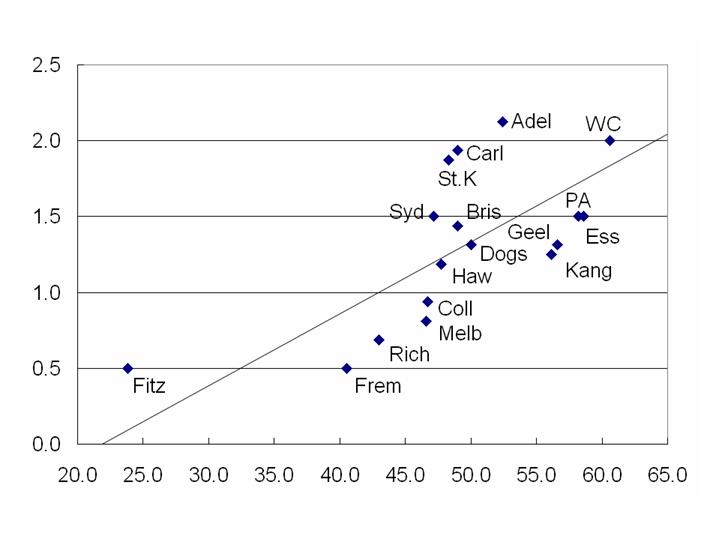
The table above, however, is slightly misleading. The line in the graph below shows the predicted average number of All-Australians for each team given their winning percentage since 1991.[1] The under-represented teams are below the line, and the over-represented teams are above it. Clearly, the teams with the lowest winning percentages (Collingwood, Melbourne, Richmond and Fremantle) tend to have a much lower representation in the All-Australian team than their actual winning percentages would suggest. Most of the teams with high winning percentages (Essendon, Port Adelaide, Geelong and the Kangaroos) have also been under-represented. It is the teams in the middle of the pack (Adelaide, Carlton and St. Kilda) that the All-Australian selectors have tended to favour.


Winning percentages and Average No. of All-Australians (1991-2006)


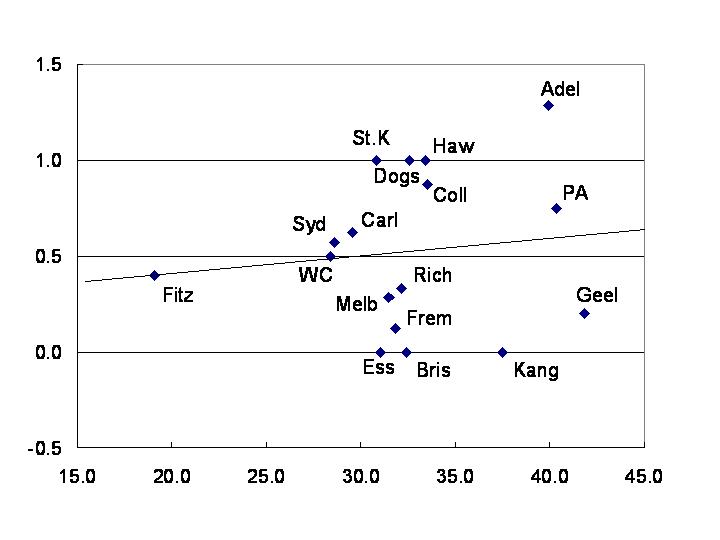
One possible theory for why teams with low winning percentages are relatively under-represented is that these teams tend to have ‘really bad’ seasons in which they clearly do not deserve any All-Australian selections. In fact, on average, the winning percentages of these teams during their ‘sub-par’ seasons (in which they win less than 50 per cent of their games) are no worse than the average club. Given their records in sub-par seasons, Melbourne, Richmond and Fremantle are all still under-represented during those seasons. Collingwood, on the other hand, is over-represented in sub-par seasons (otherwise known as the ‘Nathan Buckley effect’). Other teams that are noticeably over-represented in sub-par seasons include St. Kilda, the Bulldogs, Hawthorn, and particularly Adelaide. However, despite Adelaide’s reasonable record in sub-par seasons, winning a decent amount of games during your ‘bad’ seasons doesn’t tend to help your players’ chances of All-Australian selection that much. In particular, Geelong and the Kangaroos tend to win a significantly higher percentage of games than most other clubs during their bad seasons, but their players have either rarely or (in the Kangaroos’ case) never been rewarded with All-Australian selection in those years.


Winning percentages and Average No. of All-Australians in sub-par seasons
(1991-2006)


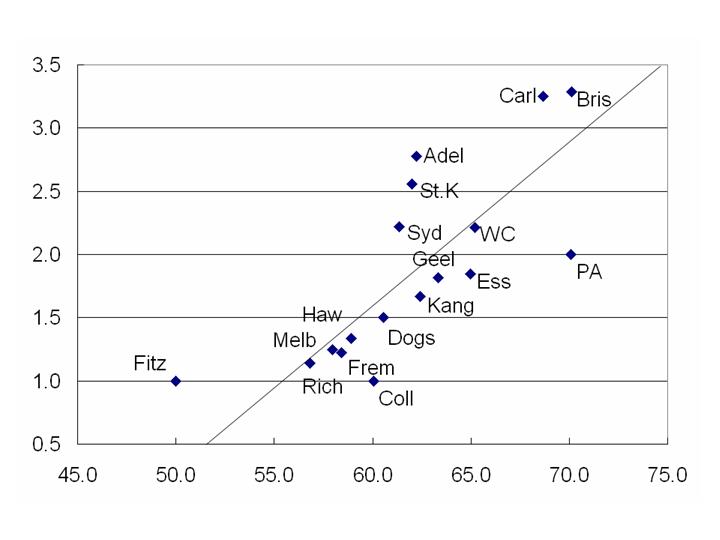
So how do teams fare when they have ‘above-par’ seasons (i.e. when they win 50 per cent or more of their games)? Again, Adelaide and St. Kilda are big winners given their records in those seasons, while Carlton and Brisbane also fare particularly well. Port Adelaide, on the other hand, is a big loser; their winning percentage in above-par seasons is much higher than most other clubs, yet there are several clubs who have a higher average number of All-Australians during those seasons. Collingwood’s players also tend to get overlooked whenever the Magpies have a good season, a fact that will validate the views of black-and-white fans everywhere. But this apparent snub notwithstanding, there may in fact be a good reason for Collingwood's under-representation overall. Compared to other clubs, Collingwood’s above-par seasons don’t tend to be ‘super’ seasons, that is, their winning percentage during those seasons is lower than the majority of clubs. Once your team’s winning percentage gets past 50 per cent, your players stand a much better chance of gaining All-Australian selection the more games you win than if your team’s winning percentage is less than 50 per cent (to see this, compare the slope of the line in the graph below to that in the one above). So it seems that the reason that Collingwood, Melbourne, Richmond and Fremantle are generally under-represented given their respective winning percentages is that they don’t tend to have really good seasons in which they would gain a whole swag of All-Australian selections (unless, of course, you’re Port Adelaide). In the end, being ‘middle of the road’ just doesn’t cut it with the selectors.


Winning percentages and Average No. of All-Australians in above-par seasons
(1991-2006)


Of course, we should note that just because a team is over-represented or under-represented in the All-Australian team, it doesn’t necessarily mean that there is any bias on the part of the selectors. For instance, fans of clubs that are under-represented in the All-Australian team may argue that their team is more than the sum of its parts. Or a team may have a strong group of players without having any noticeable stars. Or, alternatively, a team may have over or under-achieved given the talent on their list. A possible method of checking whether or not the selectors do in fact hold any biases towards or against particular teams is to see how many Brownlow Medal votes each team has received since 1991, and then compare this with their average number of All-Australian selections.

Nevertheless, some patterns seem to have emerged from the selections to date. Even so, there is no guarantee that such patterns will continue. Who knows – perhaps one day the selectors will decide that the Crows’ stars aren’t actually that good after all?


[1] Given they only played for six seasons after the All-Australian concept was introduced Fitzroy are excluded from the regression line.