Page 1 – Welcome to my running diary of the final book in the Harry Potter ‘septology’ – the ominously titled ‘Harry Potter and the Deathly Hallows’. I thought of marking my progress by the clock, but have decided, in the interests of preventing people from knowing how slowly I read, to use the page count instead.
So here we are, and the question that every reader is asking is: which major characters are headed to the great Quidditch field in the sky? I’m going to assume that Harry, Ron and Hermione are all untouchable; Hagrid looks to be a possibility (five books too late for Robbie Coltrane’s liking); McGonagall seems unlikely given Dumbledore’s recent ‘death’; Neville is a possibility; Snape and Malfoy are definite possibilities, particularly if JK goes the Anakin Skywalker route; all the other Weasleys, except maybe Ginny, seem to be fair game; Lupin, Moody and Tonks are probably too minor for their deaths to cause much of a stir; ditto for Luna Lovegood. All things considered, I’m going to go for Snape and Mr.Weasley. And Lord Voldemort…? I think he’s toast.
(Another point I should add: it took me forty-five minutes to queue up and receive a copy. I was put into this huge, snake-like line that wound its way through every nook and cranny of the second floor of Borders. And I discovered something: there are a lot of boring books in the world. There really are.)
Page 7 – JK opens with some ominous quotations about death as ‘the grinding scream’ but also as ‘but crossing the world, as friends do the seas’. I’d say the first quotation is meant to describe Voldemort, the second our dearly departed Dumbledore. Nice touch.
Page 11 – Is Snape throwing the Dark Lord off Harry’s trail with his talk about Confundus charms? I wonder who Voldermort’s prisoner is? Hope it’s not poor Neville.
Page 17 – Nope, not Neville; it’s a teacher from Hogwarts. Voldemort seems to be testing Snape’s loyalty here.
Page 24 – Harry’s just read an article filling in the details of Dumbledore’s life. At the end of the last book I didn’t really believe that Dumbledore was dead, but I’ve since been assured that it’s so. However, I reckon he’s still going to have a major presence in this volume, a la Obi-Wan Kenobi. ‘Use the Fawkes, Harry… the Fawkes…,’
Page 47 – The first example of a standard JK device that’s served her well over the course of the series: give the chapter an intriguing title – i.e. ‘The Seven Potters’ - and then use an interesting magic trick to push the story forward, in this case, turning Harry’s friends into doppelgangers of himself to put the Death Eaters off the track. Throw in a few jokes, and the kiddies are hooked.
Page 52 – No! The Death Eaters killed Hedwig! JK, you filthy murderer! I wonder how the kiddies who got the free owls from Borders are feeling now…
Page 69 – And now Mad-Eye Moody’s gone (along with George Weasley’s ear). JK, you blood-hungry slaughterer! Jeez, seventy pages in and already we’re three characters down. (At this rate, the bodycount will be up to two dozen by the book’s end.) Is there an R-rating sticker hidden under the barcode here?
Page 83 – Good to see that, even sans Hogwarts, the Potter/Weasley/Granger detective team will still be in full swing.
Page 99 – ‘then she was kissing him as she had never kissed him before, and Harry was kissing her back, and it was blissful oblivion, better than Firewhisky; she was the only real thing in the world…’ Harry and Ginny have never seemed quite right to me; a bit too schmoopie and cutesy-pie perhaps. In fact, no girl has ever really seemed right for Harry; to me, he’s more of a lone wolf, the boy who carries a burden nobody else can share. Maybe Harry and Ginny have been hooked up to emphasise this point.
Page 101 – What’s up with Lupin?
Page 119 – Note to whoever makes the film of this book: make Hermione’s dress for the wedding lilac-coloured, or I’ll be hearing about it from my lovely fiancé for the next five years. You may not think it’s important, but believe me, it is. Please, just do me this favour.
Page 122 – It’s all a bit too happy at the moment with Bill and Fleur’s wedding. If this keeps up, I may have to turn on the Collingwood versus Essendon match to remind myself of what true evil is.
Page 133 – ‘The Ministry has fallen. Scrimgeour is dead.’ JK, you callous wordsmith! (I realize that’s not much of an insult, but I can’t really muster up that much indignation about Scrimgeour.)
Page 158 – Mundungus Fletcher stole a Horcrux, hey? Curiouser and curiouser… While the fantastical elements of Harry have often been cited as the series’ main appeal, I think equal credit should be given to JK’s ability to sustain a mystery. She’s very good at concocting twists and turns and at letting out just the right amount of information at just the right time. There’s been more wand-waving action from ‘Order of the Phoenix’ onwards, but mysteries and puzzles still remain key components of Harry’s success.
Page 176 – Ah, so that’s it… Lupin and Tonks are having a kid, and Lupin’s doing a Rabbit Bergstrom on them. I wonder if it will be an ‘inside’ or an ‘outside’ baby?
Page 180 – Rita Skeeter is sullying Dumbledore’s name again, claiming that his family imprisoned his sister for being a ‘Squib’. Er, I don’t think so. But there’s obviously a few skeletons left in the good Professor’s closet.
Ooh, here’s Mundungus…
Page 182 – Mundungus just dropped the F-word. I swear that 18-plus sticker must have fallen off somewhere. And bad news, the toad-woman is back, and she’s got a Horcrux.
Page 186 – SNAPE CONFIRMED AS HOGWARTS HEADMASTER. Haha, suffer Snape, you missed out on Defence Against the Dark Arts again.
Page 195 – I can’t be certain, but I think our heroes are addicted to Polyjuice Potion. Blood, swearing, and drug references - Harry really is corrupting the world’s youth.
Page 206 – Eewww. The toad-woman has the late Moody’s mad-eye stuck on her office door. The Ministry of Magic is taking a distinctly more Orwellian turn with every page.
Page 227 – Harry’s got the Horcrux and has hung it around his neck. If he starts stroking it and calling it ‘my precious’ I think we’re in trouble.
Page 236 – Now they’re taking turns to wear the Horcrux as they journey along. Clever move. Frodo Baggins could’ve learnt a lot from these kids.
Page 254 – Well, something’s up with Ron. He’s dropped the F-bomb, implied that Harry is a egotist (young Ron’s always had a bit of an inferiority complex), reduced Hermione to tears, and stormed back home. I’d forgotten that Harry, Ron and Hermione are always good for a spat. Now it’s just Harry and Hermione in the tent. Time for some more of that ‘blissful oblivion’, ‘ey ‘arry?
Page 263 – Whoa-! Don’t look now, but Harry and Hermione are on the Polyjuice Potion again.
Page 268 – There’s one mystery solved, namely when Harry’s adventures take place. The gravestones of Harry’s parents say they died in 1981, which would mean that the series takes place during the mid to late 1990s. I bet you all knew that already, didn’t you?
(The news is showing all the Potter fans lining up to grab a copy of the book as soon as possible. Some people even camped outside bookstores overnight. What were they thinking? And why did I line up for almost an hour this morning? I could’ve gone in at 11 o’clock and walked right up to the counter. It’s lucky that no-one reads books anymore.)
Page 285 – Harry’s wand has been split in two. JK, you heartless destroyer!
Page 295 – Is Dumbledore the paragon of virtue that Harry thought he was? Hard to believe Rita’s claims that Dumbledore wanted to rule Muggles ‘for the greater good’. It’s also hard to believe that Dumbledore would leave this much to chance. I suspect that, as always, the fun will be in the explanation.
Page 303 – Ron’s back! Huzzah! (Er, why did he ever leave?)
Page 308 – Ben Cousins is back! Boooo!
It looks as if Ron may have finally conquered his fears about being a ‘second banana’. An aside: where does Ron rank in the ‘second banana’ hall of fame? I’d put him above Sam Gamgee (not as subservient), Doctor Watson (not as outclassed) and Robin (not as useless), but below Sancho Panza (not as wise), Agent 99 (not as pretty) and Waylon Smithers (not as amusing). A good comparison would be former Chicago Bull Scottie Pippen – always in the superstar’s shadow, but that superstar wouldn’t have been as great without him.
Page 328 – Merlin’s pants! So that’s what that triangular symbol is… the Deathly Hallows!
Page 348 – Three objects in the Hallows – an unbeatable wand, a resurrection stone, and an invisibility cloak - three heroes who are each looking to wield one of those objects. It would have been tempting to make this final chapter all about Harry versus Voldemort, but JK has really focused upon the Harry/Ron/Hermione triumvirate instead. Not that we should be too surprised I guess, after all, they’ve solved every other case as a team. However, I’m still thinking that, in the end, it will be up to Harry to win the day.
By the way, with all this finding of Horcruxes and collecting of Hallows, I feel like I’m in a role playing game.
Page 356 – Tonks’ father is dead. Did JK create such a large cast of characters just so she could decimate them later?
Page 360 – Oh, Harry, what have you done? You’ve said You-Know-Who’s name…
Page 373 – Harry and friends are in the hands of the enemy, who all seem spooked senseless about the Dark Lord themselves. Say what you want about Voldemort, but you can’t say he doesn’t know how to keep his troops in line.
Page 381 – In a rather gruesome scene, Wormtail has just strangled himself. JK, you brutal executioner!
Page 384 – Dobby the house-elf is back. I have a feeling that in her current mood JK will do away with him too.
Page 385 – Yep, she did. JK, you pitiless assassin! You know, in this case, it seems like JK brought Dobby back just so she could put a knife through his chest. Sure, he helped Harry escape the Malfoys, but another plot device could have easily done the trick. What happened to the author who turned time around to save Buckbeak?
Page 405 – Dumbledore had the unbeatable wand, and Voldemort has raided his tomb to get it. Sounds bad, but I reckon that if a corpse could smile, that of the former Head of Hogwarts would be doing so at the moment.
Page 416 – Lupin and Tonks now have a kid. They’d better be careful: everything small and lovable must go! (Where’s Crookshanks?)
Page 429 – It’s looking rather simple to break into Gringotts, the goblin bank. All you need is to be jacked up on Polyjuice and a few choice spells.
Page 435 – Finally we get to the scene depicted on the cover: Harry, Ron and Hermione being set upon by a rising tide of treasure. Another aside: which is the best Harry cover? (I’m only counting the covers to the kids’ versions here.) The cover to book three, with Harry riding the Hippogriff, is the one that comes most readily to mind, although like most of the covers, it’s still a little too cartoon-like for my tastes. (Yeah, yeah, I know, it’s a children’s book.) By that measure, the covers to books four and seven come out on top, with seven being my pick because it’s in trendy black and it has a bit more action in it. Hey, I just noticed the goblin hiding behind Harry’s shoulder. Extra points for that as well.
Page 445 – The final Horcrux is at Hogwarts. It’s all set for a Luke Skywalker/Darth Vader/Emperor Palpatine-type showdown. If Snape does turn out to be evil, I’m as big a fool as Obi-Wan Kedumbledore.
Page 451 – Our heroes’ mysterious benefactor has been revealed: it’s Aberforth Dumbledore. I’ll take this as the final sign that Albus is not returning.
Page 459 – Neville’s back! How did we get through three-quarters of the book without him? Lucky for him he’s shot up lately so he no longer falls into the ‘small and lovable’ category. Not that this will stop JK, I suspect…
Page 475 – And here’s McGonagall – the gang’s all here…
Page 482 – Snape’s just learned to never mess with McGonagall. But he’ll be back.
Page 489 – Welcome to ‘The Battle of Hogwarts’. On this side we have Harry, Ron, Hermione, the Weasleys, Hagrid, McGonagall, Lupin, Kingsley, and assorted Hogwarts teachers and students. On the other side, we have Lord Voldemort and uh… whoever he hasn’t killed yet. That angel of death, JK Rowling, is hovering overhead. Expect blood, mayhem, courage, valour and Harry to go all Frodo Baggins on us as Voldemort tries to infiltrate his mind. We’ve been waiting two and a half thousand pages for this. Bring it on…
(I’m sitting on the train headed to the football as I’m writing this, with Wolfmother blaring on my headphones, because a) it seems appropriate; and b) it prevents some smart-alec from telling me the ending. If they do, well, a 600-page hardcover to the nose won’t be pleasant, will it?)
Page 507 – Gee, Malfoy was always a wuss, but he’s become ever more fearful as the series has gone on. Crabbe is definitely the leader of the Slytherin trio now.
Page 510 – Crabbe has been killed. JK, you… er, screw it, it’s Crabbe.
Page 512 – Fred is dead! Not Fred! JK, you malicious slayer! And since another person has died, it must be the end of a chapter. You know, at the rate people are being knocked off, I’m starting to feel quite worried for Harry…
Page 520 – Hagrid has disappeared, but I’m going to refrain from calling JK any more names because I’m not certain that Hagrid is gone for good. Although being carried off by giant spiders while carrying a pink umbrella would be a funny way for Hagrid to go.
Page 522 – We’ve been getting a medley of Hogwarts landmarks in these past few chapters – the Room of Requirement, the Chamber of Secrets, the Shrieking Shack, the Whomping Willow… ah, the memories…
Page 525 – Fast running out of victims, JK has resurrected Harry’s parents just so she can kill them off again. OK, that one didn’t really happen.
Page 528 – Snape has just had his Anakin Skywalker moment, with Voldemort killing him off so that he can use the Elder Wand. Some may think this is Snape’s just deserts, but I think we’re about to find out otherwise.
Page 531 – Lupin and Tonks are dead. Yep, it’s a clean sweep of the friends of Harry’s dad. A pity, because I always thought Lupin and Sirius were two of the better Harry characters. JK is foaming at the mouth right about now.
Page 534 – We’re near the end, so it looks like it’s time for a classic Harry Potter ‘final explanation’. It’s hard to pick a favourite one of these; Quirrell in Philosopher’s Stone, Riddle in Chamber of Secrets, Lupin and Sirius in Azkaban… they’ve all been good.
In this case we’re looking back at the life and times of Severus Snape.
Page 548 – Hey hey, as I expected, Dumbledore’s death was part of a plan between him and Snape. Of course, I also thought Dumbledore wasn’t really dead, so I can’t pat myself on the back too hard.
Page 551 – What?! Harry has to – die?!
JK, you miserable, wretched, horrible, despicable, vile, shameful, dire, contemptible, appalling, loathsome, terrible, ghastly…
If this happens I’ll never read another Harry book again!
Page 556 – Colin Creevey is no more. ‘He was tiny in death’. Poor little guy never had a chance.
Page 561 – Here come the ghosts of victims past to help our hero along. I must confess that I thought the most moving moment in all of Harry Potter folklore was when Harry saw his parents in the Mirror of Erised. I thought it summed up both the advantages and the limits of Harry’s world quite nicely.
Page 564 – Hagrid’s alive, but who cares because now it’s Harry versus Voldermort!
Uh… Harry…
Page 566 – Whew! Harry’s not dead. And here comes his teacher to do his Obi Wan Kedumbledore routine.
Page 576 – The answers are simple: Dumbledore stuffed up. You know, now that I think about it, his plans really did suck, but that long white beard always fooled you into thinking he knew what he was doing. I think this is meant to be a part of Harry’s development though.
Page 584 – Harry, pretending to be dead, is carried back by Voldemort to the waiting throngs at Hogwarts. Anyone who skipped straight to the ending would be having a heart attack as they read this. Serves them right.
Page 589 – ‘NOT MY DAUGHTER, YOU BITCH!’ shouts Mrs Weasley. Come on, you have to laugh at that. I hope they put it in the movie.
Page 592 – Now here we are – the final duel between Harry and Voldemort.
Page 594 – I think Harry has you outsmarted here, Voldemort.
Page 595 – ‘I am the true master of the Elder Wand,’ says Harry. Not long now…
Page 596 – Bang! Voldemort’s dead! The crowd erupts!
I’m sorry I ever doubted you, JK. But why should I be surprised? This is ‘The Boy Who Lived’.
Page 600 – Harry wins the day, scores one billion points for Gryffindor. He decides to relinquish the Elder Wand. ‘That wand’s more trouble than it’s worth,’ says Harry, ‘I’ve had enough trouble for a lifetime.’ Amen to that.
Page 607 – And we finish off with a scene set nineteen years later in which Harry and Ginny see their kids off to Hogwarts. It’s OK, but I would’ve found the ending on page 600 just as nice. I guess I’m not that sentimental.
And that’s it folks. I’ll finish off with some final reflections on the series. I guess I really think of it as two series – one pre-Goblet and one post-Goblet. The pre-Goblet stories were fairly simple, self-contained tales, each of them centered on the English school life and its eccentricities, with a bit of fantasy thrown into the mix. A mixture of C.S. Lewis and Roald Dahl would be a reasonable description for the early Harry books – just when you thought you had Harry’s world sussed out then the students would break out into the ludicrous Hogwarts theme song or something of the sort. The post-Goblet Harry books still had that sense of humour, but they were meant to be taken a bit more seriously as Harry matured and the threat of Voldemort grew. These later books, clocking in at twice the page count of the first three volumes, were more expansive, more impressive in their scope, but also more meandering, losing some of the tightness of the early plots. By the final two books, we’ve clearly veered into the territory of epic young adult fantasy. JK Rowling’s efforts to break out of the constraints of the 300-page children’s novel and grow with her audience are admirable, but in hindsight I think the series really did peak with ‘Chamber of Secrets’ and ‘Prisoner of Azkaban’.
One thing that is undeniable is that the Harry Potter series has made a lot of people very happy. Even today as I was reading my book outside the Melbourne Cricket Ground with my headphones on full blast people wanted to talk me about how the book was going. The success of Harry may be, as Nassim Nicholas Taleb called it, ‘a black swan’ (i.e. a rare, high-impact event that no-one would have predicted), but that success could never have been sustained without the books being enjoyable to both kids and adults alike. If I ever have kids, I’ll make sure that Mum has a set of Harry Potter books for them to read. And I won’t let them watch the movies until they do.
Saturday, July 21, 2007


Sunday, July 1, 2007
The Finger Points Outwards - No.2
Is this the greatest game ever? (Well, it might get old after the first ten minutes or so, but I'd take it over Deal or No Deal any day.)
Japanese Tetris
While I'm sure everyone will love the first site, this one may be a bit more of an acquired taste. It apparently started out as a tongue-in-cheek website, but then some people started using it seriously. I would be disqualified from joining due to my webbed toes and nose hair.
Darwin Dating
Japanese Tetris
While I'm sure everyone will love the first site, this one may be a bit more of an acquired taste. It apparently started out as a tongue-in-cheek website, but then some people started using it seriously. I would be disqualified from joining due to my webbed toes and nose hair.
Darwin Dating
Thursday, June 14, 2007
Ravenhair (Why Did You Smile?)
Ravenhair
Did I put you off your guard
When I went and closed my eyes?
Your sweet head dropped
And your early-train thoughts
Flew away, out the window
Did I put you off your guard
When I went and closed my eyes?
Your sweet head dropped
And your early-train thoughts
Flew away, out the window
Wednesday, June 13, 2007
The Finger Points Outwards - No.1
In the wake of my 'seemingly-not-so-exhaustive-after-all' history on Marvel Comics' The Avengers, I was asked to contribute an article to the excellent website Avengers Forever. (I did publicize my Avengers history in the forum of this website... this blog isn't yet well-known enough for me to get random requests.) You can view the article here.
For those people who are Avengers fans, I recommend looking around the rest of the website for other Avengers-related goodies, including reviews, interviews, articles, wallpapers, and so on. (I concede that the odds of an Avengers fan finding the website through this blog rather than the reverse are tiny to say the least.) For those people who still think I'm talking about the Ralph Fiennes-Uma Thurman movie, this article may appeal to you more than the one I posted here - it's shorter and more personal - the type of article that you might expect would appear on my blog (go figure).
Anyway, since most of the articles I've written over the past year have been either comic book or football related maybe it's time I got a suggestion box. Anyone want a running diary of my upcoming trip to Adelaide? 'What Lurks In O'Connell Street' - it practically writes itself.
For those people who are Avengers fans, I recommend looking around the rest of the website for other Avengers-related goodies, including reviews, interviews, articles, wallpapers, and so on. (I concede that the odds of an Avengers fan finding the website through this blog rather than the reverse are tiny to say the least.) For those people who still think I'm talking about the Ralph Fiennes-Uma Thurman movie, this article may appeal to you more than the one I posted here - it's shorter and more personal - the type of article that you might expect would appear on my blog (go figure).
Anyway, since most of the articles I've written over the past year have been either comic book or football related maybe it's time I got a suggestion box. Anyone want a running diary of my upcoming trip to Adelaide? 'What Lurks In O'Connell Street' - it practically writes itself.
Saturday, June 9, 2007
Fact or Crap?: AFL Myths Debunked
Fact or Crap?: While many facets of the AFL have improved over the years, goal-kicking accuracy isn’t one of them.
CRAP: Goal-kicking accuracy has been improving ever since the VFL/AFL began. Over the first forty seasons (1897-1936), it improved from 39 per cent to 48 per cent, before dipping a little over the next thirty seasons. However, since the mid-1960s it has been on a clear upward trend, peaking at 55.2 per cent in season 2000. While it has deteriorated a little over the past couple of seasons, today’s players still rank high in terms of goal-kicking accuracy.

Fact or Crap?: The competition is more even nowadays than is has ever been.
CRAP: In terms of the closeness of matches, the competition is basically no more even than it has been since the 1920s. The average winning margin was about 10 points smaller back then, but since the average score was about 30 points smaller, it is fair to say the average game was just as tight. Perhaps games are slightly closer than they were 10 years ago, but the distance between the studs and the spuds still remains.

Fact or Crap?: Non-Victorian teams are less affected by travelling interstate than Victorian teams.
CRAP: Since Port Adelaide entered the AFL in 1997, non-Victorian teams have had a better winning percentage than Victorian teams when they travel interstate, but that partly reflects the fact that they are better teams! When we compare each team’s winning percentage when playing in their home city to their winning percentage when they are playing interstate, the Kangaroos, Geelong and the Western Bulldogs are the three teams that suffer least from playing on the road. In comparison, the chance of either West Coast or Fremantle winning a match is significantly reduced once they fly east of the Nullabor. Most of the other non-Victorian teams don’t suffer too badly in comparison, but they are not the seasoned travellers that many people believe.
Fact or Crap?: It is much harder to win the week after traveling interstate.
CRAP: Below is the combined winning percentage of teams in the week after traveling to different cities since 1997.
The winning percentage for teams the week after traveling interstate is 55.8 per cent, only slightly lower than the overall winning percentage for teams playing in their home city of 56.3 per cent. On the other hand, it appears it is a bit tougher to win the week after traveling to Perth or Sydney.
Fact or Crap?: Collingwood travel interstate less than other Victorian teams.
FACT: Since 1997, Collingwood have played a higher percentage of games in their home state than any other team, with 81.5 per cent. The other ‘big four’ Victorian teams – Carlton, Essendon, and Richmond - fill out positions two to four. Unsurprisingly, the Kangaroos are the Victorian team which travels the most, playing only 68.6 per cent of their games in Victoria.
Fact or Crap?: The mid-season ladder leader has a good chance of winning the premiership.
FACT: The figure below shows the percentage of premiers that have been on top of the ladder after each round since 1931 (before this year, when the final four system was introduced, the minor premiers had a significant advantage in the finals). While there is no more than a one-in-four chance that the ladder leader in any of the first seven rounds will go on to win the premiership, after that, it tends to be about 40 per cent or higher. (The peak is at round 18 which is partly due to the VFL running an 18-match season from 1931 to 1967.)

Thanks to afl.allthestats.com for providing the statistics for this article.
CRAP: Goal-kicking accuracy has been improving ever since the VFL/AFL began. Over the first forty seasons (1897-1936), it improved from 39 per cent to 48 per cent, before dipping a little over the next thirty seasons. However, since the mid-1960s it has been on a clear upward trend, peaking at 55.2 per cent in season 2000. While it has deteriorated a little over the past couple of seasons, today’s players still rank high in terms of goal-kicking accuracy.

Fact or Crap?: The competition is more even nowadays than is has ever been.
CRAP: In terms of the closeness of matches, the competition is basically no more even than it has been since the 1920s. The average winning margin was about 10 points smaller back then, but since the average score was about 30 points smaller, it is fair to say the average game was just as tight. Perhaps games are slightly closer than they were 10 years ago, but the distance between the studs and the spuds still remains.

Fact or Crap?: Non-Victorian teams are less affected by travelling interstate than Victorian teams.
CRAP: Since Port Adelaide entered the AFL in 1997, non-Victorian teams have had a better winning percentage than Victorian teams when they travel interstate, but that partly reflects the fact that they are better teams! When we compare each team’s winning percentage when playing in their home city to their winning percentage when they are playing interstate, the Kangaroos, Geelong and the Western Bulldogs are the three teams that suffer least from playing on the road. In comparison, the chance of either West Coast or Fremantle winning a match is significantly reduced once they fly east of the Nullabor. Most of the other non-Victorian teams don’t suffer too badly in comparison, but they are not the seasoned travellers that many people believe.
| Team | Away winning % | Home winning % | Ratio |
| Kangaroos | 44.4 | 57.0 | 0.78 |
| Geelong | 45.6 | 60.7 | 0.75 |
| Bulldogs | 38.3 | 52.0 | 0.74 |
| Adelaide | 47.3 | 65.2 | 0.73 |
| Sydney | 43.9 | 65.2 | 0.67 |
| Brisbane | 43.5 | 68.9 | 0.63 |
| Collingwood | 29.5 | 47.4 | 0.62 |
| Port Adelaide | 41.8 | 67.2 | 0.62 |
| Carlton | 25.0 | 40.0 | 0.60 |
| Melbourne | 30.0 | 51.1 | 0.59 |
| Essendon | 35.4 | 62.4 | 0.57 |
| Hawthorn | 25.9 | 46.7 | 0.55 |
| Richmond | 25.5 | 46.7 | 0.55 |
| West Coast | 36.2 | 69.2 | 0.52 |
| Fremantle | 25.0 | 55.9 | 0.45 |
| St. Kilda | 23.3 | 55.0 | 0.42 |
| Victorian | 34.8 | 51.9 | 0.67 |
| Non-Victorian | 40.4 | 65.6 | 0.62 |
Fact or Crap?: It is much harder to win the week after traveling interstate.
CRAP: Below is the combined winning percentage of teams in the week after traveling to different cities since 1997.
| City | Combined winning % of AFL teams in week after travelling to city |
| Geelong | 60.1 |
| Adelaide | 59.1 |
| Brisbane | 57.8 |
| Melbourne | 55.9 |
| Sydney | 53.7 |
| Perth | 51.2 |
| Total | 55.8 |
The winning percentage for teams the week after traveling interstate is 55.8 per cent, only slightly lower than the overall winning percentage for teams playing in their home city of 56.3 per cent. On the other hand, it appears it is a bit tougher to win the week after traveling to Perth or Sydney.
Fact or Crap?: Collingwood travel interstate less than other Victorian teams.
FACT: Since 1997, Collingwood have played a higher percentage of games in their home state than any other team, with 81.5 per cent. The other ‘big four’ Victorian teams – Carlton, Essendon, and Richmond - fill out positions two to four. Unsurprisingly, the Kangaroos are the Victorian team which travels the most, playing only 68.6 per cent of their games in Victoria.
Fact or Crap?: The mid-season ladder leader has a good chance of winning the premiership.
FACT: The figure below shows the percentage of premiers that have been on top of the ladder after each round since 1931 (before this year, when the final four system was introduced, the minor premiers had a significant advantage in the finals). While there is no more than a one-in-four chance that the ladder leader in any of the first seven rounds will go on to win the premiership, after that, it tends to be about 40 per cent or higher. (The peak is at round 18 which is partly due to the VFL running an 18-match season from 1931 to 1967.)

Thanks to afl.allthestats.com for providing the statistics for this article.
Monday, May 7, 2007
Flat-Track Bullies in the AFL
In the aftermath of the tedious Richmond v Geelong match, I noticed a number of references to the Cats as ‘flat-track bullies’. Certainly the evidence so far would lend support to that claim; in the three games they’ve won, Geelong has beaten the current bottom three teams by an average of 96 points. Even if you take account of the two games they’ve lost against bottom-eight teams, then they still score on average over 50 points more against teams in the lower half of the ladder.
Time will tell if the Cats keep us this form and claim the ‘flat-track bully’ crown for 2007. Ironically enough, if they do, the team they would be taking over from is… Richmond. The Tigers racked up nine out of their eleven wins over bottom-eight teams last year, scoring on average 21.9 points more than their opposition. In contrast, against top-eight teams, they scored on average 44.2 points less than their opposition – a differential of a whopping 66.1 points.
Does this mean Geelong is doomed to finish ninth this year? We’ll see. In the meantime, here’s the ‘flat-track bully’ ladder for 2006:
Time will tell if the Cats keep us this form and claim the ‘flat-track bully’ crown for 2007. Ironically enough, if they do, the team they would be taking over from is… Richmond. The Tigers racked up nine out of their eleven wins over bottom-eight teams last year, scoring on average 21.9 points more than their opposition. In contrast, against top-eight teams, they scored on average 44.2 points less than their opposition – a differential of a whopping 66.1 points.
Does this mean Geelong is doomed to finish ninth this year? We’ll see. In the meantime, here’s the ‘flat-track bully’ ladder for 2006:
| Team | Average point differential against bottom eight teams less average point differential against top eight teams: 2006 |
| Richmond | 66.1 |
| Collingwood | 46.0 |
| Hawthorn | 45.6 |
| Bulldogs | 44.4 |
| St. Kilda | 39.1 |
| Kangaroos | 36.4 |
| Adelaide | 35.9 |
| Sydney | 27.5 |
| Brisbane | 23.4 |
| Geelong | 23.1 |
| West Coast | 21.1 |
| Melbourne | 20.5 |
| Port | 19.7 |
| Carlton | 13.9 |
| Essendon | 11.6 |
| Fremantle | 5.5 |
Saturday, May 5, 2007
Avengers Assemble!: A Pseudo-Critical History of The Avengers - Part VI
Master of the World
While ‘Heroes Reborn’ had sold bucket loads of copies, The Avengers as a whole had become derailed, and so it was left to writer Kurt Busiek and artist George Perez to return the group to their former glory with yet another new series. They brought back the classic line-up, the classic costumes, and many of the classic foes. More importantly, they put a great deal of thought into their stories, eschewing pin-ups and ‘shock events’ in favour of careful craftsmanship. Busiek, with his encyclopedic knowledge of Avengers history, is never short of a story to tell, but far from simply re-hashing the old stories, Busiek is adept at working out what makes the characters tick. Perez’s artwork is not quite as pretty as his first run but the amount of detail more than makes up for it. In a move that almost seems as if it were designed to point out the vapidity of ‘Heroes Reborn’ the opening pages of issue v.3 #1 has Perez drawing the various Avengers fighting in no less than thirteen different locations. Perez backs up this effort in the very next issue when he re-designs 39 costumes! Together, Busiek and Perez brought back the fun the series had during the 1970s and early 1980s, while upping the ante for a generation who had grown up on video games and movie blockbusters.
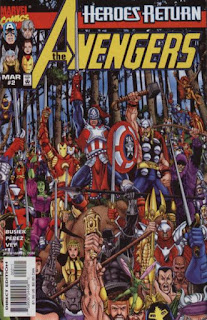
A major part of their efforts was to expand the scale and location of the Avengers’ battles. When the Avengers faced down the cosmic-level menace of Michael Korvac the whole battle was confined to a house in suburban New York, but now the size of the threat is proportional to the size of the battlefield. In the key stories of the Busiek/Perez run the Avengers fight Count Nefaria in the Alberta mountains, Morgan Le Fey in the English highlands, and Ultron in the fictional Baltic nation of Slorenia. In each case, about a dozen or more heroes are thrown at the villains, bouncing off in all directions. Perez’s eye for detail makes each of these locations distinctive, and his artwork clearly shows the effects that the ravages of combat have on the scenery. However, the biggest battle of them all takes place in the fifteen-part ‘The Kang Dynasty’ (issues v.3 #41-55), in which Kang declares war on 21st century Earth. In this story, we see the Avengers travel to New York, Washington, Los Angeles, Canada, Siberia, France, and outer space in order to stop Kang and his various armies. Perez has left by this time, although the fact that five different artists are used to complete the story adds to its scope.
While all these villains, particularly Kang and Ultron, have no qualms about killing, mass murder is not their ultimate goal. In fact, all of them plan to preserve life, but to re-make it in their own image. Morgan Le Fay wants to be ruler of a medieval society, Ultron wants to create a world of mechanical life with himself as the ‘patriarch’, Count Nefaria wants to irradiate the world so that they will treat him with respect, and Kang wants to turn the human race into an intergalactic army. Hence, the Avengers are not fighting to save the world per se, but are fighting to save it from being re-ordered to the will of their enemies. Despite their ambitions for a new and ‘better’ world, these villains are not the visionaries they would like to think they are. Captain America calls Kang a ‘miserable, jacked-up little tin Hitler…’ (v. 3 #52) and like the Third Reich Kang’s world consists of concentration camps, axes of evil, and theories of the ubermensch. When Captain America, now a giant symbol of liberty, faces down Kang in issues #52-53, we may as well be back in 1941 (or at least 1964-65). As we shall see with Geoff Johns’ run there’s a sense in which drawing such close parallels with Nazi fascism places the Avengers somewhat behind the times. Instead, what pushed Busiek’s stories forward were the new angles he placed on the characters’ emotional pasts.
Time To Think
One relationship that Busiek would pick up and put a new shine on was the love triangle between the Scarlet Witch, the Vision and Wonder Man, who the Vision’s mind was based upon. Since we last saw them together in issue #255 the Vision and Wanda’s lives have been rather haphazard – they moved to the West Coast, the Vision’s memory was erased, he moved back to the East Coast (thus effectively ending their marriage), Wonder Man declared his love for Wanda, Wonder Man died… again, and the Vision and Wanda were transported to an alternate reality. In issue v.3 #2, Busiek has Wanda mysteriously resurrect Wonder Man, which would seem to further complicate matters. In fact, Busiek manages to bring it all to a head. The Vision is jealous of Wanda and Simon’s burgeoning relationship, but not for the obvious reason. To the Vision’s mind, their relationship is the ultimate proof that his entire identity is merely a facsimile of Simon’s, revealing him ‘as nothing, as less than nothing…. A copy that is no longer necessary, now that the original is back.’ (v.3 #23) Wonder Man, however, has a different point of view. ‘You got a clean slate –,’ he tells the Vision, after a long recount of his numerous mistakes, ‘You got to be the person I lost – the boy I was before I went wrong.’ (v.3 #23) That seems to be exactly the thing that the Vision needed to hear, because when he returns to the Avengers he is a much more contented android. ‘I have accepted that I am responsible for my own life,’ he tells Wanda, ‘my own happiness,’ (v. 3 #31). Now it is Wanda and Simon who are seemingly cast adrift, unsure of where they are headed. The resolution to their relationship comes, strangely enough, in one of Kang’s concentration camps. ‘It wasn’t the kind of love either of us thought,’ says Simon, ‘More like –,’ ‘More like what we really are is old, old friends,’ Wanda replies (v.3 #51). It’s the clearest, most peaceful thought that either of them has had in years.

If the Vision and company are relieved to put the past behind them, that’s nothing compared to what Henry Pym feels when he finally puts his evil creation Ultron down for good. In issue v.3 #22, Hank makes the startling revelation that he based the mass-murdering robot’s brain patterns on his own. The Vision was haunted by the idea that he was simply ‘the reflection’ (v.3 #23), but Hank’s reflection is a grinning, metal mask ‘stripped of conscience, of morality… what I must think – somewhere deep inside –,’ (v.3 #22) Like the Vision though, he comes to accept that he is more than what the other side of the mirror shows him. ‘You’re not me – you’re just a bad experiment --,’ he shouts as he tears Ultron to pieces, ‘and here and now – I’m ending it!’ (v.3 #22) The image of a sweat-soaked, breathless Hank collapsing into Jan’s arms is a reminder that winning the day is as much about relief as it is about triumph. One ghost still remains in the closet though – Yellowjacket. One may have thought that this had been done and dusted in the 1980s, but Busiek shows there is still one stone left unturned. He reveals that Yellowjacket represented Hank’s ‘impulsive, emotional, expressive side’ (Annual 2001), his desire to be the bravest, most fearless hero of them all. When Henry Pym locked his Yellowjacket costume away, he closed off a part of him self that he needed to confront; the post-YJ Hank, by contrast, is too cautious, too over-protective. With Jan’s help, Hank finally accepts that ‘there’ll always be someone braver out there – someone more powerful… someone smarter too,’ and that all he needs to be is ‘the best Hank Pym’ he can be (Annual 2001). Following this revelation, Hank takes up the Yellowjacket moniker again, reasoning that ‘it’s as Yellowjacket that I had my worst problems – so it’s as Yellowjacket that I’ll face them…,’ (v.3 #45) The result is a strangely more exuberant Hank than the one we have become used to, but after all the problems he has faced, who is going to hold that against him?
While Busiek’s tales of redemption for the older members work well, those for the newer breed are somewhat less interesting. The over-eager Justice is struck with a bad case of hero-worship, to the point where he is almost ready to quit the Avengers because he doesn’t think he can measure up. He finally feels like an important part of the team when he helps Hank beat Ultron, but this development hardly wins any points for originality and the story would probably have worked just as well if Hank had found another way to win. Triathlon, meanwhile, is the latest in an assembly line of Avengers with shady backgrounds, although to Busiek’s credit, he does show how it can be pretty weary to be the outsider. Triathlon, of course, ends up saving the earth, the universe, and all that, but like Justice, just when he feels he is part of the team, his time with them comes to an end. It seems that, in the case of the older Avengers, Busiek has a talent for turning the convoluted into the complex; however, his own additions travel along fairly standard story arcs, after which they really have nowhere left to go. Considering that Busiek’s other main successes have been Marvels, which was a re-telling of the history of the Marvel Universe, and Astro City, which was based around a re-imagining of heroic archetypes, one could postulate that he does his best work when the groundwork is already laid out for him (this isn’t necessarily a bad thing, after all, Shakespeare never came up with his own plots). By the end of ‘The Kang Dynasty’ Busiek has tied up a lot of the loose ends that other writers had left for him, so it’s not surprising that he decides to make his exit. He had, however, left the Avengers in much better shape than he found them.
I’ll Be Watching Over You
‘Trust men, and they will be true to you; treat them greatly and they will show themselves great.’[26] So says the last panel of writer Geoff Johns’ final issue of The Avengers (v.3 #76), and it describes his twenty-issue run in a nutshell. It begins with the United Nations asking the Avengers to take charge of the entire world, and ends with Ant-Man finally accepting the Jack of Hearts as an Avenger. And through it all, there are several cases where the characters place their trust in those they may have doubted or mistrusted in the past, who each in turn prove able to repay that trust.

In ‘World Trust’ (issues v.3 #57-60) the United Nations, having decided that they are ill-equipped to deal with a state of global emergency, ‘relinquish the reins of leadership’ (v.3 #57) to Earth’s Mightiest Heroes. Despite the team’s predominantly American membership, the implication is that the Avengers are the super-powered equivalent of the UN: a supra-national entity that the world’s governments can call upon to restore order. ‘America. China. Even Iraq, for God’s sake -’ says the recently returned Henry Gyrich, ‘they all trust the Avengers.’ (v.3 #58) Actually, one of the messages of Johns’ run is that governments as a whole can not be trusted; trust is always built face-to-face. When Gyrich is hanging around the Avengers as a government representative they all treat him like something they just stepped in, whereas when the Falcon takes him aside to perform a secret mission for him, he comes through. Similarly, in ‘World Trust’, when the UN delegates are too busy looking out for national interests to address the global emergency, Iron Man defuses the situation by removing his facemask to reveal that he is Anthony Stark, billionaire industrialist. Most notably, in the aftermath of the ‘Red Zone’ incident (issues v.3 #65-70), in which the U.S. Government had an indirect hand, trust is rebuilt through a one-on-one chat between Captain America and the US President.[27] ‘If there are any other bio-weapons labs in the country –,’ says the Captain, ‘I trust they are being shut down.’ (v.3 #70) ‘We’re already in the process of finding out,’ replies the President, ‘And if we make a mistake of any kind again – I trust you will be there to help us correct it.’ Governments can be dangerous once they hide behind their offices; while trust is an important quality, one needs to stare them in the eye every now and then.
If trust is an important quality to have, being able to repay that trust is equally important. At the start of ‘Red Zone’, Cap promises a young boy whose parents have just been killed by the virus that ‘we’re going to get you home’. (v.3 #65) Five issues later, we see the young boy safe in hospital, the Vision’s hand on his shoulder. ‘You’re going home soon,’ he tells the boy, ‘Captain America gave you his word. And the Avengers always help him keep it.’ (v.3 #70) Part of learning to repay people’s trust is repaying that of your teammates. When Ant-Man and the Jack of Hearts are throwing childish insults at each other, Cap quickly breaks it up and stresses the importance of them getting along. ‘We work together as a team. We strive for perfection. So leave your faults at the mansion door.’ (v.3 #57) Iron Man and the Black Panther demonstrate this when they put aside their mutual distrust and work together to stop the ‘Red Zone’ virus. Standing behind Cap when he breaks up the feuding Avengers is the Falcon, his arms crossed and a stern expression on his face. The Falcon is Johns’ exemplar of someone who can be trusted to do the right thing by his teammates. ‘Now I live by a different set of words.’ he tells the reader in v.3 #64, “Avengers Assemble.” It means go in fighting – and watch each other’s backs.’ In particular, the trust between Captain America and the Falcon has reached the point where they do not even question each other’s judgments. ‘You proved yourself to Falcon --,’ says Cap to Gyrich, ‘meaning you proved yourself to me.’ (v.3 #70)
While it’s true that Johns’ stories are able to convey his respect for the characters, too often they seem like stooges to the story’s main message. The ongoing feud between Ant-Man and the Jack of Hearts seems particularly forced, and they both come off looking like jerks (although issue v.3 #62, which shows that they have more in common than they think, is one of the better issues of the run). Gyrich’s new-found humility before Cap and the Falcon is like watching a fish learn how to tap-dance - particularly given his conceit during ‘World Trust’ - and the strong distrust between Iron Man and the Black Panther makes you wonder if you missed the story where the Panther personally ripped apart the circuit board of every computer in Stark Industries. Finally, the revelation the Red Skull is behind the ‘bio-terrorist’ attack in ‘Red Zone’ is mildly disappointing. While the message behind the menace of the Skull, ‘treat all men with respect’, is certainly as applicable now as it was during the rise of Nazi Germany, the Skull’s fascist policies and racist remarks seem almost anachronistic when compared to the murky, messy problems that America faces in the post 9/11 era. All of this is not to say that the Johns’ run is a bad one – the stories are thoughtful and Johns does a good job of handling the changes in artist every second issue - it’s just that, more often than not, it seems the characters are saying what the creators think we want to hear.
OK, Ya Li’l Pishers… Time To End This
Johns’ successor as Avengers writer, Chuck Austen, quickly allows Earth’s Mightiest Heroes to regress to the level of fifteen year-olds, with his blend of self-congratulatory jokes, references to teen-slasher movies, and lengthy dialogues on pubescent-like sexual fantasies.[28] Austen’s first story, ‘Lionheart of Avalon’ (v.3 #77-81), deals chiefly with the subject of violence against women, and manages to muff it completely. The hero of the piece is Kelsey Leigh, a British mother of two, who becomes the new Captain Britain after she is beaten to death trying to defend Captain America from the villainous Wrecking Crew. Let it be noted that Kelsey already carries a disfiguring scar upon her face as the result of trying to defend herself from a burglar/rapist several years ago. And then Kelsey strikes out a third time when she is given the opportunity to carry the sword Excalibur, and is promptly forbidden to reveal that she is alive to her two children, lest they die a horrible death. Apparently, as Cap says, a mother of two defending her self is a pretty ‘stupid’ thing to do. Continuing on the mixed messages, Hawkeye encourages Cap to re-think his position on beating up super-powered women on the basis that chivalry is outdated, but then, when Kelsey dies, charges off like the proverbial white knight to fight the entire Wrecking Crew. At least Hawkeye doesn’t come off like a Neanderthal like poor Hank Pym, who twenty years after his breakdown, suddenly looks like he is going to throttle Jan at any moment. And it seems now that Hank is a mother-hating misogynist: ‘I have no trouble at all believing a mother would abandon her kids.’ he says in reference to Kelsey’s new-found powers, ‘She’s given power, freedom, and a new look all in one flash. A lot of women would jump at that.’ (v.3 #82)
Austen’s second story-line, ‘Once An Invader’ (v.3 #82-84), is a slight improvement, in which Austen uses the Invaders moniker to comment on modern-day American imperialism, as the New Invaders, led by Captain America-wannabe the U.S. Agent, overthrow a Middle Eastern government.[29] However, given the complexity of the subject, the level of political analysis is sadly lacking, going no further than lines such as ‘To truly honor the country… you must honor the world’ (v.3 #84). Austen also repeats Johns’ mistake by tying the Invaders to the Red Skull (‘He had some good ideas’ says the Agent (v.3 #84)), which blithely papers over the differences between Nazi fascism and US foreign policy. Now approaching issue #500, The Avengers really needed a good shake-up. Without a doubt they would soon receive it.
Few stories in Avengers history have divided fans as much as Brian Michael Bendis and David Finch’s ‘Chaos’, which ran through issues #500-503 (the title returned to its original numbering at this point). The advance publicity proclaimed drastic changes to the make-up of the Avengers, with some old favourites slated to bite the dust and marquee characters such as Spider-Man and Wolverine earmarked as their replacements. The unprecedented buzz surrounding the book, provided by the combination of the internet and Bendis’ relatively high industry profile, also gave fans plenty of opportunity to voice their distaste, with Bendis, by all reports, being subject to a barrage of personal attacks as he promised to wreak havoc upon the team. And wreak havoc he did. By the time the Avengers slink off into the sunset in issue #503, Ant-Man and Hawkeye are dead, the Vision has been ripped in half, the Wasp is incapacitated, She-Hulk has gone berserk, and the woman behind all the madness, the Scarlet Witch, has been reduced to a mindless vegetable.

Whereas over two hundred issues ago, Simonson and Buscema had dismantled the Avengers with barely a whimper, Bendis and Finch rain hell on the team. Disaster follows upon disaster to nightmarish effect: a decrepit Jack of Hearts blows up the mansion, an Avengers quinjet destroys what’s left, a Kree armada attacks, and so on. While Bendis is renowned for his dialogue, he knows when to keep quiet and let the events take their proper space. The long, vertical panels showing Captain America watching, in shock and despair, as the Vision flies the quinjet kamikaze-style into the mansion, are truly gut-wrenching. But as with the Simonson/Buscema story, the Avengers are attacked mentally as well as physically. This most obviously manifests itself in incidents like Iron Man threatening to kill a UN delegate, but more broadly, the extraordinary sequence of events leads to questions about the team’s modus operandi. ‘We had it coming…’ says Hawkeye, ‘We’re all about whatever is in front of us that second, and then we’re on to the next thing.’ (#501) Hawkeye’s words echo Ms. Marvel’s claim in Annual #10 that the Avengers are too inclined to take things at face value. And ultimately, the Scarlet Witch’s breakdown is partly caused by the Avengers not helping Wanda come fully to terms with the loss of her children, which she had inexplicably willed into existence.[30]
All these changes led to Bendis being heavily criticized for disrespecting the Avengers’ past, with such criticisms probably carrying more weight due to ‘Chaos’ being Bendis’ first Avengers story. But in fact, ‘Chaos’ draws heavily upon the characters’ past, from key events such as Tony Stark’s battle with alcoholism to lesser known stories such as John Byrne’s ‘Dark Scarlet Witch’ saga, which was told over in Avengers West Coast. After the Scarlet Witch has been carried off by her father Magneto, and the Avengers say their goodbyes, there is a flashback to issue #16, in which the Scarlet Witch, along with Quicksilver and Hawkeye, first joins the Avengers. While it’s a reminder of a happier, simpler time, notably some of the panels are missing, as the story focuses in on Wanda and Pietro’s induction into the team. And therein lies the crux of what ‘Chaos’ is trying to achieve – it is not writing over history, but taking only the parts it needs to move the Avengers forward. In the end, history is nothing but what you make of it.
Coda: All Those Possibilities…
In issue #10 of the Avengers Forever series, the Time-Keepers tell the Avengers that, because of the threat that humanity poses to the multiverse, they will isolate humanity, destroying all but the minimum of timelines which are necessary. When Captain America asks in what percentage of timelines humanity actually turns bad, they reply that ‘Forty-two percent of existing timelines are thus damaged by humanity.’ (Avengers Forever #10) Captain America is outraged, ‘That’s less than half?!... We probably won’t do these things, in most realities, we don’t… that’s not justice!‘
We have seen the Avengers go through good and bad times; they have been both a help and a hindrance to the world and to themselves. But through it all there’s the belief that, more often that not, things will turn out OK. What matters to them is that others be free to realize their full potential, wherever it may lead them. While there’s a certain appeal to having everything the way you like it, forever and ever, life goes on, and new possibilities are opened up.[31] Some will work, and some will not - fate has a ‘quirky’ way of working sometimes. ‘It’s the new Avengers! Hooray!!’ shout the crowds as Captain America and his ‘kooky quartet’ step into the limelight for the first time (#16, reprinted in #503). What could possibly be more positive than that?
Covers copyright Marvel Comics
[26] Johns is quoting Ralph Waldo Emerson.
[27] George W. Bush, though in Marvel tradition he is never named.
[28] Artist Olivier Coipel’s predilection for child-like faces, while fine when he is drawing for other writers, doesn’t help matters.
[29] The original Invaders, which included Captain America and the Sub-Mariner among its members, actually banded together to fight against the Nazi and Japanese invasions in World War II.
[30] Children?! Yes, the Vision and the Scarlet Witch had twin boys, but it was revealed years later that it was actually impossible for an android to procreate, and that Wanda had used her hex powers to create them. Once the children were destroyed, Wanda had no memory of them, until a chance remark by the Wasp brought the pain of her loss flooding back.
[31] And yes, for the record, I think the Avengers have too many members.
While ‘Heroes Reborn’ had sold bucket loads of copies, The Avengers as a whole had become derailed, and so it was left to writer Kurt Busiek and artist George Perez to return the group to their former glory with yet another new series. They brought back the classic line-up, the classic costumes, and many of the classic foes. More importantly, they put a great deal of thought into their stories, eschewing pin-ups and ‘shock events’ in favour of careful craftsmanship. Busiek, with his encyclopedic knowledge of Avengers history, is never short of a story to tell, but far from simply re-hashing the old stories, Busiek is adept at working out what makes the characters tick. Perez’s artwork is not quite as pretty as his first run but the amount of detail more than makes up for it. In a move that almost seems as if it were designed to point out the vapidity of ‘Heroes Reborn’ the opening pages of issue v.3 #1 has Perez drawing the various Avengers fighting in no less than thirteen different locations. Perez backs up this effort in the very next issue when he re-designs 39 costumes! Together, Busiek and Perez brought back the fun the series had during the 1970s and early 1980s, while upping the ante for a generation who had grown up on video games and movie blockbusters.

A major part of their efforts was to expand the scale and location of the Avengers’ battles. When the Avengers faced down the cosmic-level menace of Michael Korvac the whole battle was confined to a house in suburban New York, but now the size of the threat is proportional to the size of the battlefield. In the key stories of the Busiek/Perez run the Avengers fight Count Nefaria in the Alberta mountains, Morgan Le Fey in the English highlands, and Ultron in the fictional Baltic nation of Slorenia. In each case, about a dozen or more heroes are thrown at the villains, bouncing off in all directions. Perez’s eye for detail makes each of these locations distinctive, and his artwork clearly shows the effects that the ravages of combat have on the scenery. However, the biggest battle of them all takes place in the fifteen-part ‘The Kang Dynasty’ (issues v.3 #41-55), in which Kang declares war on 21st century Earth. In this story, we see the Avengers travel to New York, Washington, Los Angeles, Canada, Siberia, France, and outer space in order to stop Kang and his various armies. Perez has left by this time, although the fact that five different artists are used to complete the story adds to its scope.
While all these villains, particularly Kang and Ultron, have no qualms about killing, mass murder is not their ultimate goal. In fact, all of them plan to preserve life, but to re-make it in their own image. Morgan Le Fay wants to be ruler of a medieval society, Ultron wants to create a world of mechanical life with himself as the ‘patriarch’, Count Nefaria wants to irradiate the world so that they will treat him with respect, and Kang wants to turn the human race into an intergalactic army. Hence, the Avengers are not fighting to save the world per se, but are fighting to save it from being re-ordered to the will of their enemies. Despite their ambitions for a new and ‘better’ world, these villains are not the visionaries they would like to think they are. Captain America calls Kang a ‘miserable, jacked-up little tin Hitler…’ (v. 3 #52) and like the Third Reich Kang’s world consists of concentration camps, axes of evil, and theories of the ubermensch. When Captain America, now a giant symbol of liberty, faces down Kang in issues #52-53, we may as well be back in 1941 (or at least 1964-65). As we shall see with Geoff Johns’ run there’s a sense in which drawing such close parallels with Nazi fascism places the Avengers somewhat behind the times. Instead, what pushed Busiek’s stories forward were the new angles he placed on the characters’ emotional pasts.
Time To Think
One relationship that Busiek would pick up and put a new shine on was the love triangle between the Scarlet Witch, the Vision and Wonder Man, who the Vision’s mind was based upon. Since we last saw them together in issue #255 the Vision and Wanda’s lives have been rather haphazard – they moved to the West Coast, the Vision’s memory was erased, he moved back to the East Coast (thus effectively ending their marriage), Wonder Man declared his love for Wanda, Wonder Man died… again, and the Vision and Wanda were transported to an alternate reality. In issue v.3 #2, Busiek has Wanda mysteriously resurrect Wonder Man, which would seem to further complicate matters. In fact, Busiek manages to bring it all to a head. The Vision is jealous of Wanda and Simon’s burgeoning relationship, but not for the obvious reason. To the Vision’s mind, their relationship is the ultimate proof that his entire identity is merely a facsimile of Simon’s, revealing him ‘as nothing, as less than nothing…. A copy that is no longer necessary, now that the original is back.’ (v.3 #23) Wonder Man, however, has a different point of view. ‘You got a clean slate –,’ he tells the Vision, after a long recount of his numerous mistakes, ‘You got to be the person I lost – the boy I was before I went wrong.’ (v.3 #23) That seems to be exactly the thing that the Vision needed to hear, because when he returns to the Avengers he is a much more contented android. ‘I have accepted that I am responsible for my own life,’ he tells Wanda, ‘my own happiness,’ (v. 3 #31). Now it is Wanda and Simon who are seemingly cast adrift, unsure of where they are headed. The resolution to their relationship comes, strangely enough, in one of Kang’s concentration camps. ‘It wasn’t the kind of love either of us thought,’ says Simon, ‘More like –,’ ‘More like what we really are is old, old friends,’ Wanda replies (v.3 #51). It’s the clearest, most peaceful thought that either of them has had in years.

If the Vision and company are relieved to put the past behind them, that’s nothing compared to what Henry Pym feels when he finally puts his evil creation Ultron down for good. In issue v.3 #22, Hank makes the startling revelation that he based the mass-murdering robot’s brain patterns on his own. The Vision was haunted by the idea that he was simply ‘the reflection’ (v.3 #23), but Hank’s reflection is a grinning, metal mask ‘stripped of conscience, of morality… what I must think – somewhere deep inside –,’ (v.3 #22) Like the Vision though, he comes to accept that he is more than what the other side of the mirror shows him. ‘You’re not me – you’re just a bad experiment --,’ he shouts as he tears Ultron to pieces, ‘and here and now – I’m ending it!’ (v.3 #22) The image of a sweat-soaked, breathless Hank collapsing into Jan’s arms is a reminder that winning the day is as much about relief as it is about triumph. One ghost still remains in the closet though – Yellowjacket. One may have thought that this had been done and dusted in the 1980s, but Busiek shows there is still one stone left unturned. He reveals that Yellowjacket represented Hank’s ‘impulsive, emotional, expressive side’ (Annual 2001), his desire to be the bravest, most fearless hero of them all. When Henry Pym locked his Yellowjacket costume away, he closed off a part of him self that he needed to confront; the post-YJ Hank, by contrast, is too cautious, too over-protective. With Jan’s help, Hank finally accepts that ‘there’ll always be someone braver out there – someone more powerful… someone smarter too,’ and that all he needs to be is ‘the best Hank Pym’ he can be (Annual 2001). Following this revelation, Hank takes up the Yellowjacket moniker again, reasoning that ‘it’s as Yellowjacket that I had my worst problems – so it’s as Yellowjacket that I’ll face them…,’ (v.3 #45) The result is a strangely more exuberant Hank than the one we have become used to, but after all the problems he has faced, who is going to hold that against him?
While Busiek’s tales of redemption for the older members work well, those for the newer breed are somewhat less interesting. The over-eager Justice is struck with a bad case of hero-worship, to the point where he is almost ready to quit the Avengers because he doesn’t think he can measure up. He finally feels like an important part of the team when he helps Hank beat Ultron, but this development hardly wins any points for originality and the story would probably have worked just as well if Hank had found another way to win. Triathlon, meanwhile, is the latest in an assembly line of Avengers with shady backgrounds, although to Busiek’s credit, he does show how it can be pretty weary to be the outsider. Triathlon, of course, ends up saving the earth, the universe, and all that, but like Justice, just when he feels he is part of the team, his time with them comes to an end. It seems that, in the case of the older Avengers, Busiek has a talent for turning the convoluted into the complex; however, his own additions travel along fairly standard story arcs, after which they really have nowhere left to go. Considering that Busiek’s other main successes have been Marvels, which was a re-telling of the history of the Marvel Universe, and Astro City, which was based around a re-imagining of heroic archetypes, one could postulate that he does his best work when the groundwork is already laid out for him (this isn’t necessarily a bad thing, after all, Shakespeare never came up with his own plots). By the end of ‘The Kang Dynasty’ Busiek has tied up a lot of the loose ends that other writers had left for him, so it’s not surprising that he decides to make his exit. He had, however, left the Avengers in much better shape than he found them.
I’ll Be Watching Over You
‘Trust men, and they will be true to you; treat them greatly and they will show themselves great.’[26] So says the last panel of writer Geoff Johns’ final issue of The Avengers (v.3 #76), and it describes his twenty-issue run in a nutshell. It begins with the United Nations asking the Avengers to take charge of the entire world, and ends with Ant-Man finally accepting the Jack of Hearts as an Avenger. And through it all, there are several cases where the characters place their trust in those they may have doubted or mistrusted in the past, who each in turn prove able to repay that trust.

In ‘World Trust’ (issues v.3 #57-60) the United Nations, having decided that they are ill-equipped to deal with a state of global emergency, ‘relinquish the reins of leadership’ (v.3 #57) to Earth’s Mightiest Heroes. Despite the team’s predominantly American membership, the implication is that the Avengers are the super-powered equivalent of the UN: a supra-national entity that the world’s governments can call upon to restore order. ‘America. China. Even Iraq, for God’s sake -’ says the recently returned Henry Gyrich, ‘they all trust the Avengers.’ (v.3 #58) Actually, one of the messages of Johns’ run is that governments as a whole can not be trusted; trust is always built face-to-face. When Gyrich is hanging around the Avengers as a government representative they all treat him like something they just stepped in, whereas when the Falcon takes him aside to perform a secret mission for him, he comes through. Similarly, in ‘World Trust’, when the UN delegates are too busy looking out for national interests to address the global emergency, Iron Man defuses the situation by removing his facemask to reveal that he is Anthony Stark, billionaire industrialist. Most notably, in the aftermath of the ‘Red Zone’ incident (issues v.3 #65-70), in which the U.S. Government had an indirect hand, trust is rebuilt through a one-on-one chat between Captain America and the US President.[27] ‘If there are any other bio-weapons labs in the country –,’ says the Captain, ‘I trust they are being shut down.’ (v.3 #70) ‘We’re already in the process of finding out,’ replies the President, ‘And if we make a mistake of any kind again – I trust you will be there to help us correct it.’ Governments can be dangerous once they hide behind their offices; while trust is an important quality, one needs to stare them in the eye every now and then.
If trust is an important quality to have, being able to repay that trust is equally important. At the start of ‘Red Zone’, Cap promises a young boy whose parents have just been killed by the virus that ‘we’re going to get you home’. (v.3 #65) Five issues later, we see the young boy safe in hospital, the Vision’s hand on his shoulder. ‘You’re going home soon,’ he tells the boy, ‘Captain America gave you his word. And the Avengers always help him keep it.’ (v.3 #70) Part of learning to repay people’s trust is repaying that of your teammates. When Ant-Man and the Jack of Hearts are throwing childish insults at each other, Cap quickly breaks it up and stresses the importance of them getting along. ‘We work together as a team. We strive for perfection. So leave your faults at the mansion door.’ (v.3 #57) Iron Man and the Black Panther demonstrate this when they put aside their mutual distrust and work together to stop the ‘Red Zone’ virus. Standing behind Cap when he breaks up the feuding Avengers is the Falcon, his arms crossed and a stern expression on his face. The Falcon is Johns’ exemplar of someone who can be trusted to do the right thing by his teammates. ‘Now I live by a different set of words.’ he tells the reader in v.3 #64, “Avengers Assemble.” It means go in fighting – and watch each other’s backs.’ In particular, the trust between Captain America and the Falcon has reached the point where they do not even question each other’s judgments. ‘You proved yourself to Falcon --,’ says Cap to Gyrich, ‘meaning you proved yourself to me.’ (v.3 #70)
While it’s true that Johns’ stories are able to convey his respect for the characters, too often they seem like stooges to the story’s main message. The ongoing feud between Ant-Man and the Jack of Hearts seems particularly forced, and they both come off looking like jerks (although issue v.3 #62, which shows that they have more in common than they think, is one of the better issues of the run). Gyrich’s new-found humility before Cap and the Falcon is like watching a fish learn how to tap-dance - particularly given his conceit during ‘World Trust’ - and the strong distrust between Iron Man and the Black Panther makes you wonder if you missed the story where the Panther personally ripped apart the circuit board of every computer in Stark Industries. Finally, the revelation the Red Skull is behind the ‘bio-terrorist’ attack in ‘Red Zone’ is mildly disappointing. While the message behind the menace of the Skull, ‘treat all men with respect’, is certainly as applicable now as it was during the rise of Nazi Germany, the Skull’s fascist policies and racist remarks seem almost anachronistic when compared to the murky, messy problems that America faces in the post 9/11 era. All of this is not to say that the Johns’ run is a bad one – the stories are thoughtful and Johns does a good job of handling the changes in artist every second issue - it’s just that, more often than not, it seems the characters are saying what the creators think we want to hear.
OK, Ya Li’l Pishers… Time To End This
Johns’ successor as Avengers writer, Chuck Austen, quickly allows Earth’s Mightiest Heroes to regress to the level of fifteen year-olds, with his blend of self-congratulatory jokes, references to teen-slasher movies, and lengthy dialogues on pubescent-like sexual fantasies.[28] Austen’s first story, ‘Lionheart of Avalon’ (v.3 #77-81), deals chiefly with the subject of violence against women, and manages to muff it completely. The hero of the piece is Kelsey Leigh, a British mother of two, who becomes the new Captain Britain after she is beaten to death trying to defend Captain America from the villainous Wrecking Crew. Let it be noted that Kelsey already carries a disfiguring scar upon her face as the result of trying to defend herself from a burglar/rapist several years ago. And then Kelsey strikes out a third time when she is given the opportunity to carry the sword Excalibur, and is promptly forbidden to reveal that she is alive to her two children, lest they die a horrible death. Apparently, as Cap says, a mother of two defending her self is a pretty ‘stupid’ thing to do. Continuing on the mixed messages, Hawkeye encourages Cap to re-think his position on beating up super-powered women on the basis that chivalry is outdated, but then, when Kelsey dies, charges off like the proverbial white knight to fight the entire Wrecking Crew. At least Hawkeye doesn’t come off like a Neanderthal like poor Hank Pym, who twenty years after his breakdown, suddenly looks like he is going to throttle Jan at any moment. And it seems now that Hank is a mother-hating misogynist: ‘I have no trouble at all believing a mother would abandon her kids.’ he says in reference to Kelsey’s new-found powers, ‘She’s given power, freedom, and a new look all in one flash. A lot of women would jump at that.’ (v.3 #82)
Austen’s second story-line, ‘Once An Invader’ (v.3 #82-84), is a slight improvement, in which Austen uses the Invaders moniker to comment on modern-day American imperialism, as the New Invaders, led by Captain America-wannabe the U.S. Agent, overthrow a Middle Eastern government.[29] However, given the complexity of the subject, the level of political analysis is sadly lacking, going no further than lines such as ‘To truly honor the country… you must honor the world’ (v.3 #84). Austen also repeats Johns’ mistake by tying the Invaders to the Red Skull (‘He had some good ideas’ says the Agent (v.3 #84)), which blithely papers over the differences between Nazi fascism and US foreign policy. Now approaching issue #500, The Avengers really needed a good shake-up. Without a doubt they would soon receive it.
Few stories in Avengers history have divided fans as much as Brian Michael Bendis and David Finch’s ‘Chaos’, which ran through issues #500-503 (the title returned to its original numbering at this point). The advance publicity proclaimed drastic changes to the make-up of the Avengers, with some old favourites slated to bite the dust and marquee characters such as Spider-Man and Wolverine earmarked as their replacements. The unprecedented buzz surrounding the book, provided by the combination of the internet and Bendis’ relatively high industry profile, also gave fans plenty of opportunity to voice their distaste, with Bendis, by all reports, being subject to a barrage of personal attacks as he promised to wreak havoc upon the team. And wreak havoc he did. By the time the Avengers slink off into the sunset in issue #503, Ant-Man and Hawkeye are dead, the Vision has been ripped in half, the Wasp is incapacitated, She-Hulk has gone berserk, and the woman behind all the madness, the Scarlet Witch, has been reduced to a mindless vegetable.

Whereas over two hundred issues ago, Simonson and Buscema had dismantled the Avengers with barely a whimper, Bendis and Finch rain hell on the team. Disaster follows upon disaster to nightmarish effect: a decrepit Jack of Hearts blows up the mansion, an Avengers quinjet destroys what’s left, a Kree armada attacks, and so on. While Bendis is renowned for his dialogue, he knows when to keep quiet and let the events take their proper space. The long, vertical panels showing Captain America watching, in shock and despair, as the Vision flies the quinjet kamikaze-style into the mansion, are truly gut-wrenching. But as with the Simonson/Buscema story, the Avengers are attacked mentally as well as physically. This most obviously manifests itself in incidents like Iron Man threatening to kill a UN delegate, but more broadly, the extraordinary sequence of events leads to questions about the team’s modus operandi. ‘We had it coming…’ says Hawkeye, ‘We’re all about whatever is in front of us that second, and then we’re on to the next thing.’ (#501) Hawkeye’s words echo Ms. Marvel’s claim in Annual #10 that the Avengers are too inclined to take things at face value. And ultimately, the Scarlet Witch’s breakdown is partly caused by the Avengers not helping Wanda come fully to terms with the loss of her children, which she had inexplicably willed into existence.[30]
All these changes led to Bendis being heavily criticized for disrespecting the Avengers’ past, with such criticisms probably carrying more weight due to ‘Chaos’ being Bendis’ first Avengers story. But in fact, ‘Chaos’ draws heavily upon the characters’ past, from key events such as Tony Stark’s battle with alcoholism to lesser known stories such as John Byrne’s ‘Dark Scarlet Witch’ saga, which was told over in Avengers West Coast. After the Scarlet Witch has been carried off by her father Magneto, and the Avengers say their goodbyes, there is a flashback to issue #16, in which the Scarlet Witch, along with Quicksilver and Hawkeye, first joins the Avengers. While it’s a reminder of a happier, simpler time, notably some of the panels are missing, as the story focuses in on Wanda and Pietro’s induction into the team. And therein lies the crux of what ‘Chaos’ is trying to achieve – it is not writing over history, but taking only the parts it needs to move the Avengers forward. In the end, history is nothing but what you make of it.
Coda: All Those Possibilities…
In issue #10 of the Avengers Forever series, the Time-Keepers tell the Avengers that, because of the threat that humanity poses to the multiverse, they will isolate humanity, destroying all but the minimum of timelines which are necessary. When Captain America asks in what percentage of timelines humanity actually turns bad, they reply that ‘Forty-two percent of existing timelines are thus damaged by humanity.’ (Avengers Forever #10) Captain America is outraged, ‘That’s less than half?!... We probably won’t do these things, in most realities, we don’t… that’s not justice!‘
We have seen the Avengers go through good and bad times; they have been both a help and a hindrance to the world and to themselves. But through it all there’s the belief that, more often that not, things will turn out OK. What matters to them is that others be free to realize their full potential, wherever it may lead them. While there’s a certain appeal to having everything the way you like it, forever and ever, life goes on, and new possibilities are opened up.[31] Some will work, and some will not - fate has a ‘quirky’ way of working sometimes. ‘It’s the new Avengers! Hooray!!’ shout the crowds as Captain America and his ‘kooky quartet’ step into the limelight for the first time (#16, reprinted in #503). What could possibly be more positive than that?
Covers copyright Marvel Comics
[26] Johns is quoting Ralph Waldo Emerson.
[27] George W. Bush, though in Marvel tradition he is never named.
[28] Artist Olivier Coipel’s predilection for child-like faces, while fine when he is drawing for other writers, doesn’t help matters.
[29] The original Invaders, which included Captain America and the Sub-Mariner among its members, actually banded together to fight against the Nazi and Japanese invasions in World War II.
[30] Children?! Yes, the Vision and the Scarlet Witch had twin boys, but it was revealed years later that it was actually impossible for an android to procreate, and that Wanda had used her hex powers to create them. Once the children were destroyed, Wanda had no memory of them, until a chance remark by the Wasp brought the pain of her loss flooding back.
[31] And yes, for the record, I think the Avengers have too many members.
Tuesday, May 1, 2007
Avengers Assemble!: A Pseudo-Critical History of The Avengers - Part V
What of the Avengers…?
Roger Stern’s departure heralds something of a decline for The Avengers, both for the title and for the team itself. Walter Simonson joins the Buscema/Palmer team for issues #291-300, in which the Avengers are torn apart by two of their own. In issues #291-293 Namor’s wife Marrina turns into a gigantic sea creature known as the Leviathian and proceeds to destroy anything that is unlucky enough to cross her path. While the Avengers eventually stop her, the battle takes a huge physical toll on the team. Namor is forced to stab the Leviathian using the Black Knight’s sword, an act that not only ends the life of his beloved, but which turns the Knight, through the sword’s curse, into a ‘living blade’. To make matters worse, the Avengers’ leader, Captain Marvel, expends so much energy in the battle that she is left powerless and incapacitated. This opens the door for Doctor Druid, who is being controlled by one of the Avengers’ foes, to use his mental powers to become chairman of the team and eventually enslave the other members. This all comes to a head in issue #297, and while this time only Druid is lost, the will of the Avengers disappears with him and the team disbands.
Some fans consider Simonson’s run to be the nadir of The Avengers but in fact it’s not as bad as its reputation suggests. There is something compelling about watching the team gradually fall apart, and there are even a few truly sublime moments, such as the Sub-Mariner’s final eulogy to the fallen Marrina and the Black Knight’s chilling scream of ‘The blood! The blood!’ as Namor stabs the Leviathian (#293). Buscema and Palmer’s artwork continues to be excellent, managing to meld together Simonson’s off-beat storytelling devices into some sort of coherent whole. Perhaps the stories’ critical flaw is that they are just a little too bleak and fatalistic; through all the various setbacks, the Avengers seem to have little regard for either the team or themselves, which ultimately leads the reader to wonder why they should care about them either.
A new team of Avengers is introduced in issue #300, which crashes and burns three issues later. John Byrne takes over as writer soon after, at which point the Avengers resort to something of a revolving line-up. While this idea certainly has possibilities in practice it leads to merely serviceable plots and little to no development of the characters.[22] Paul Ryan’s artwork is decent enough, but given that the stories are content to retread old territory the title could have used a fresher artistic vision at this point.

Larry Hama joins Ryan with issue #326, which also introduces Rage, a young African-American man who, in his denims and tiger-stripe mask, is designed to stick out like a sore thumb. He shows up at Avengers headquarters demanding to be made an Avenger, claiming the team is implicitly racist in their membership choices. Rage accuses Cap of judging him by his appearance, and says that Cap is worried that he ‘might say things to offend the nice people of Fifth Avenue…’ (#326) After the inevitable fight with the rest of the Avengers, Rage storms out, declaring that they are irrelevant anyway. ‘All you ever do is bash cosmic menaces off in some alternate reality or battle bad guys who have nothing better to do than destroy your headquarters!’ he says, rightly describing about ninety per cent of Avengers stories.[23] In fact, deep down, Rage doesn’t really think the Avengers are irrelevant; if he did then he wouldn’t be so angry with them. In issues #328 and #330, we learn that Rage is actually a bookish fourteen-year old kid who was transformed into his current super-strong incarnation when he hid in a pool of toxic waste to escape a group of bullies. Rage may therefore not only be intended to be a voice for African-American youth, but also for comic book fans in general, some of whom may feel closer to the adult heroes they read about than their own age group. Such fans have, of course, be known to be quite venomous at times about the comics they profess to love so much, their affection turning to frustration and anger when events do not pan out as they would like.[24] These emotions can often by misinterpreted by outside observers, such as when Sersi intervenes in the confrontation between Rage and Captain America, because all she can perceive is ‘the threat, and the very real anger!’ (#326)
Nevertheless, there is some value in not getting too caught up in one’s feelings. Rage’s Granny Staples acts as a moderating influence for him, admonishing him for wanting to use his new-found strength to beat up the bullies that picked on him, and pouring cold water on Rage’s acceptance into the Avengers by telling him that his costume makes him look like a hoodlum. In the end, Rage’s fantasy of fighting alongside his heroes does evaporate, as the Avengers eventually learn that he is a minor and remove him from active duty. Rage, in a sign of maturity, calmly accepts this verdict, realizing that it is time to rejoin the real world, ‘I’ve got a lot of work to do in my neighbourhood, anyway.’ (#342)
A New Type of Avenger!
The Avengers finally regain some consistency, and some of their grandeur, with the arrival of writer Bob Harras and penciller Steve Epting in the mid-330s. Harras and Epting were, in many ways, the heirs to Thomas and Buscema, especially with Buscema’s long-time art collaborator, Tom Palmer, still on board. Harras revived many of the key concepts from the Thomas days – alternate reality counterparts, intergalactic war, Arkon, the Collector, even the Vision to some extent – and blended them with Englehart’s penchant for soap-opera and on-going plotlines (although this may have owed less to Englehart’s Avengers run than to Harras’ stint as editor of the X-Men titles). Epting, meanwhile, created a modern, ‘grim and gritty’ version of the Avengers’ world that, like Buscema, generally kept the characters on edge. Although it’s a bit overdone at times, Harras and Epting bring the Avengers kicking and screaming into the 1990s, as the team update their appearance, technology and most notably, their traditional methods of operation.
The main question the Avengers face during this period is whether or not they should kill if necessary. Sersi and the Black Knight are the first members to push the issue, with Sersi threatening to destroy an entire spaceship in issue #345 if the crew does not surrender their captives, and Dane suggesting in issue #346 that he go in for the kill when the tide of battle turns against the Avengers. These cracks become an ideological chasm in issue #347, when a massive bomb obliterates the Kree galaxy, and half the team decides to hunt down and destroy the entity responsible, the Supreme Intelligence. There are two issues at stake here, the first being whether or not the Supreme Intelligence is a ‘living being’ or a machine and the second being whether or not the Avengers have a right to destroy it. For Captain America, whether the Supreme Intelligence is what we would term ‘alive’ is irrelevant, the fact remains that the Avengers ‘are not judge, jury and executioner. It is as simple as that.’ (#347) Iron Man and the Vision disagree, arguing that the Supreme Intelligence is ‘a machine… a soulless piece of hardware… that we will destroy so that nothing like this will ever happen again’. They may be right, but the Black Knight’s first response to the idea of punishing the Supreme Intelligence is revealing: ‘Let’s kill that scum.’ The Black Knight, Sersi and Hercules appear to be out for blood, for vengeance. The speed with which they destroy the Supreme Intelligence, leaving as little time as possible to back out of their mission, suggests that, instinctively, they realize they are killing a sentient being.
Ultimately, while they disagree with Iron Man and his supporters, Captain America and crew do not physically try to stop them. Soon after, Cap takes a leave of absence, during which time the Black Knight is able to impress his more aggressive fighting style upon the team. By the time Cap returns, the Avengers have become, as noted by one of their enemies, more tenacious and more savage, a notion that the Captain is not wholly uncomfortable with. ‘Maybe that’s because, over the years, the stakes have gotten higher… our enemies have become more vicious, more evil!’ he says, ‘Maybe – just maybe – it is time for a new type of Avenger!’ (#366)

Is this the sign of a paradigm shift within the Avengers? In fact, this is not as clear cut as it sounds. The Avenger who most eagerly embraces the new aggressive approach, Sersi, is not exactly in a healthy mental state at this point, and there is a growing suspicion that she is secretly murdering random strangers just for kicks. When she vaporizes an over-zealous priest in issue #359 after he ‘sacrifices’ a young girl, it is hard to tell if she is making a stand about justice, or is just looking for an excuse to let out her murderous desires. While it transpires that a man named Proctor is actually responsible for Sersi’s madness, which in theory should exonerate her of any wrongdoing, such comforts are clearly a thing of the past for the Avengers. Sersi may well have been under the control of Proctor, but the suspicion remains that Proctor simply released a desire lurking within her that could, given her level of power, ultimately imperil the entire world. The fear that this is true eventually leads her and Dane to leave this dimension for another in which Sersi can be ‘free of Proctor’s curse’ (#375). While it’s said that it’s hard to walk the path of the straight and narrow, Sersi’s predicament shows that having the will to be as ruthless as your enemies also has its price.
Appearing From The Shadows

Bob Harras’ channelling of Thomas and Englehart is most evident in his ongoing story involving the coming of the Gatherers and their attempt to kill off Sersi. The Gatherers are a group of survivors taken from dead alternate worlds, each of which has died because of the Avengers. They have come to our world because they believe that Sersi is about to destroy it, and since our world is the template for all others they are by extension attempting to save every world in existence. The notion that all worlds are merely reflections of our own would appear to take some of the sting out of the concept of alternate worlds, placing them in a subservient relationship to our own. However, the menace of the Gatherers is somewhat enhanced by their shadowy nature. One aspect of this is that, to survive on our world, the Gatherers must kill their ‘Earth Prime’ counterparts, like reflections that have come to life to murder their owners. More importantly, the Gatherers are both the source for and a reflection of much of the tension that exists for our own heroes. The first Gatherer to make his existence known is the Swordsman, counterpart of the long-dead Avenger, who casts his shadow upon the cover of issue #343. The Swordsman blames the Avengers for his death, taking a particular dislike to the Vision for his ‘affair’ with Mantis. While the Vision and the Avengers are unperturbed by the Swordsman’s accusations, the Swordsman suggests that this may be because ‘the truth is too painful’ (#344), and his re-appearance does cast some doubt on the Avengers’ nobility in the reader’s mind at least. But if the Swordsman’s appearance re-opens some old wounds for both him and the Avengers, it also offers a chance at redemption. Once he accepts that the Vision of our world is not the same character as he knew, the Swordsman and the Vision are able to become friends rather than rivals, with the Vision helping the Gatherer to adjust to our world.
On the other side of the coin, the darkest, most sinister of all the Gatherers is their leader, the red-eyed Proctor, who it turns out is using the Gatherers to take his revenge on Sersi. On his world Proctor was Sersi’s ‘Gann Josin’, which is a bonding ‘that creates a mental union between two people and makes them lifelong soulmates’ (#361). But then, years later, that world’s Sersi tired of Proctor and left him ‘discarded like a child’s toy, forgotten at day’s end’ (#374), driving Proctor mad with a thirst for revenge. At the same time as Proctor emerges the Black Knight has been made this world’s Sersi’s ‘Gann Josin’ in an effort to slow her apparent descent into madness. But in true soap-operatic style, the Knight is actually in love with another teammate, Crystal, who is in turn the estranged wife of Quicksilver. Dane’s dilemma is a reflection of the ideological shift going through the Avengers at the time: should he choose the impulsive, ruthless, uncontrollable Sersi, or the sweeter, gentler, but still powerful Crystal? Proctor is a vision of what the Black Knight may become if he chooses the former - more so than he knows, as it turns out that Proctor’s counterpart on this world is the Black Knight. But the existence of another option turns out to be Dane’s salvation: ‘I had no Crystal to love,’ Proctor tells him, ‘no innocent to save me from Sersi’s bonding… Rather, I embraced it…’ (#375) While the variations between the Avengers and their alternate-reality counterparts provide much of the tension, again it all resolves itself into a neat little symmetry in the end. As Proctor killed his world’s Sersi so does this world’s Sersi take his life, which in turn results in Sersi and Dane leaving this world, thus providing Crystal and Quicksilver with a second chance to save their marriage. Yes it’s sentimental, but like the best Avengers stories there’s a sense that you’ve just been witness to something bigger than this world and that the universe has a beautiful and fascinating order to it.
That’s not so when the other half of the Mantis/ Swordsman pairing makes her re-appearance in the next major cross-reality story, ‘The Crossing’. Unlike the Gatherers storyline, which played out its twists over the course of many months, ‘The Crossing’ reads like it was conceived to ‘shake things up’ for the Avengers as quickly as possible. Its major selling-point was that one of the key Avengers, Iron Man, was to be revealed as a traitor, who had secretly been working for Mantis and the Avengers’ old foe, Kang the Conqueror, for many years. Like most other things in this storyline, this seems like little more than an excuse to shock the readers. Kang’s and Mantis’ intentions are never really made clear; while with Proctor the gradual revelation of his plan added to the mood, here it is just tedious and infuriating. Furthermore, the Gatherers were interesting foils for the Avengers because they had both a relationship to the Avengers and a motivation for fighting them; in this case all we have is two unrelated tribes suddenly at war with each other. Mike Deodato’s pencils add some interest at least, although one is constantly in fear that all of the women’s spines are going to break. If there’s one thing that ‘The Crossing’ did get right it’s that, for the first time since the early 200s, all the classic Avengers were back on the one team again. Alas, this wasn’t enough to attract readers to the title, and less than a year later Marvel would decide to take more drastic measures.
This World Be A Joyless Place!
Although ‘The Crossing’ promised to alter The Avengers forever, its effects turned out to be remarkably short-lived. In 1996, Marvel agreed to turn over four of its longest running titles – The Avengers, Captain America, Fantastic Four and Iron Man – to popular writer/artists Jim Lee and Rob Liefeld, who, in the early 1990s, had left Marvel in order to help form Image Comics. In ‘Heroes Reborn’, Lee and Liefeld were given carte blanche to re-vamp the origins of some of Marvel’s oldest and stodgiest characters, with Liefeld taking The Avengers. The set-up was that the Avengers and the Fantastic Four had apparently sacrificed themselves to save the world, but instead had been transported to a ‘pocket reality’ with no memories of their past lives. (As part of this change, the titles were cancelled and the numbering began again from #1.) The theory was that with a blank slate before them, the creators would be free to re-create the characters from a modern-day perspective.

Considering the changes in comic books and in popular culture in general over the 30 plus years since The Avengers’ debut, one would think that Liefeld and company would see ‘Heroes Reborn’ as an opportunity to flesh out the Avengers’ mythos. Unfortunately, they take the opposite tack, and seem intent on trying to recapture past glories. There are a few novel twists – the Avengers are now a government-funded department of the espionage agency known as S.H.I.E.L.D., and as such, have to worry about public perception a bit more than their old-world counterparts.[25] For the most part, however, the stories read like an Avengers’ ‘highlights reel’, with only the barest semblance of a plot to back them up. Loki schemes, Kang tries to conquer, but the stories don’t seem particularly concerned about finding a reason for them to be there as they are with having Thor and the Hulk beat the tar out of each other. Accordingly, any storytelling abilities of the artists go out the window, replaced by pin-ups of muscle-bound morons and big breasted bimbos. The long-legged, stick-waisted figure of the Enchantress at the end of issue v.2 #1 truly defies the laws of human anatomy.
Halfway through the series Liefeld has gone, and while the writing improves slightly, the whole concept becomes even more of a shambles. The sub-plots of the first seven issues that had shown the most promise (the creation of Ultron, the revelation that the Scarlet Witch is the Enchantress’ daughter) are either downplayed or discarded, and the characters stumble along with no apparent purpose. By the end of it all, it’s all horribly depressing as the Avengers are simply playthings to be thrown around at will: they have no history, no connections, and assuredly no future, which makes whatever they are fighting for utterly pointless. ‘Maybe in the next life,’ (v.2 #13) says one of the heroes, just before the end (mercifully) comes. It would be a much happier one.
Covers copyright Marvel Comics
[22] Byrne’s concurrent work on the Avengers’ sister title, Avengers West Coast, was considerably more interesting, involving the world’s governments dismantling the Vision as a result of his attempt to take over their computer systems, and the resulting mental deterioration of the Scarlet Witch.
[23] In issue #329, in which Rage does join the team, the Avengers accept a charter from the United Nations which says that this is basically all they are allowed to do lest they offend any current member nations, but the potential conflict is never played out.
[24] Of course, this level of intensity isn’t limited to comic book fans.
[25] This theme would be expanded upon several years later in another alternate version of the Avengers: The Ultimates.
Roger Stern’s departure heralds something of a decline for The Avengers, both for the title and for the team itself. Walter Simonson joins the Buscema/Palmer team for issues #291-300, in which the Avengers are torn apart by two of their own. In issues #291-293 Namor’s wife Marrina turns into a gigantic sea creature known as the Leviathian and proceeds to destroy anything that is unlucky enough to cross her path. While the Avengers eventually stop her, the battle takes a huge physical toll on the team. Namor is forced to stab the Leviathian using the Black Knight’s sword, an act that not only ends the life of his beloved, but which turns the Knight, through the sword’s curse, into a ‘living blade’. To make matters worse, the Avengers’ leader, Captain Marvel, expends so much energy in the battle that she is left powerless and incapacitated. This opens the door for Doctor Druid, who is being controlled by one of the Avengers’ foes, to use his mental powers to become chairman of the team and eventually enslave the other members. This all comes to a head in issue #297, and while this time only Druid is lost, the will of the Avengers disappears with him and the team disbands.
Some fans consider Simonson’s run to be the nadir of The Avengers but in fact it’s not as bad as its reputation suggests. There is something compelling about watching the team gradually fall apart, and there are even a few truly sublime moments, such as the Sub-Mariner’s final eulogy to the fallen Marrina and the Black Knight’s chilling scream of ‘The blood! The blood!’ as Namor stabs the Leviathian (#293). Buscema and Palmer’s artwork continues to be excellent, managing to meld together Simonson’s off-beat storytelling devices into some sort of coherent whole. Perhaps the stories’ critical flaw is that they are just a little too bleak and fatalistic; through all the various setbacks, the Avengers seem to have little regard for either the team or themselves, which ultimately leads the reader to wonder why they should care about them either.
A new team of Avengers is introduced in issue #300, which crashes and burns three issues later. John Byrne takes over as writer soon after, at which point the Avengers resort to something of a revolving line-up. While this idea certainly has possibilities in practice it leads to merely serviceable plots and little to no development of the characters.[22] Paul Ryan’s artwork is decent enough, but given that the stories are content to retread old territory the title could have used a fresher artistic vision at this point.

Larry Hama joins Ryan with issue #326, which also introduces Rage, a young African-American man who, in his denims and tiger-stripe mask, is designed to stick out like a sore thumb. He shows up at Avengers headquarters demanding to be made an Avenger, claiming the team is implicitly racist in their membership choices. Rage accuses Cap of judging him by his appearance, and says that Cap is worried that he ‘might say things to offend the nice people of Fifth Avenue…’ (#326) After the inevitable fight with the rest of the Avengers, Rage storms out, declaring that they are irrelevant anyway. ‘All you ever do is bash cosmic menaces off in some alternate reality or battle bad guys who have nothing better to do than destroy your headquarters!’ he says, rightly describing about ninety per cent of Avengers stories.[23] In fact, deep down, Rage doesn’t really think the Avengers are irrelevant; if he did then he wouldn’t be so angry with them. In issues #328 and #330, we learn that Rage is actually a bookish fourteen-year old kid who was transformed into his current super-strong incarnation when he hid in a pool of toxic waste to escape a group of bullies. Rage may therefore not only be intended to be a voice for African-American youth, but also for comic book fans in general, some of whom may feel closer to the adult heroes they read about than their own age group. Such fans have, of course, be known to be quite venomous at times about the comics they profess to love so much, their affection turning to frustration and anger when events do not pan out as they would like.[24] These emotions can often by misinterpreted by outside observers, such as when Sersi intervenes in the confrontation between Rage and Captain America, because all she can perceive is ‘the threat, and the very real anger!’ (#326)
Nevertheless, there is some value in not getting too caught up in one’s feelings. Rage’s Granny Staples acts as a moderating influence for him, admonishing him for wanting to use his new-found strength to beat up the bullies that picked on him, and pouring cold water on Rage’s acceptance into the Avengers by telling him that his costume makes him look like a hoodlum. In the end, Rage’s fantasy of fighting alongside his heroes does evaporate, as the Avengers eventually learn that he is a minor and remove him from active duty. Rage, in a sign of maturity, calmly accepts this verdict, realizing that it is time to rejoin the real world, ‘I’ve got a lot of work to do in my neighbourhood, anyway.’ (#342)
A New Type of Avenger!
The Avengers finally regain some consistency, and some of their grandeur, with the arrival of writer Bob Harras and penciller Steve Epting in the mid-330s. Harras and Epting were, in many ways, the heirs to Thomas and Buscema, especially with Buscema’s long-time art collaborator, Tom Palmer, still on board. Harras revived many of the key concepts from the Thomas days – alternate reality counterparts, intergalactic war, Arkon, the Collector, even the Vision to some extent – and blended them with Englehart’s penchant for soap-opera and on-going plotlines (although this may have owed less to Englehart’s Avengers run than to Harras’ stint as editor of the X-Men titles). Epting, meanwhile, created a modern, ‘grim and gritty’ version of the Avengers’ world that, like Buscema, generally kept the characters on edge. Although it’s a bit overdone at times, Harras and Epting bring the Avengers kicking and screaming into the 1990s, as the team update their appearance, technology and most notably, their traditional methods of operation.
The main question the Avengers face during this period is whether or not they should kill if necessary. Sersi and the Black Knight are the first members to push the issue, with Sersi threatening to destroy an entire spaceship in issue #345 if the crew does not surrender their captives, and Dane suggesting in issue #346 that he go in for the kill when the tide of battle turns against the Avengers. These cracks become an ideological chasm in issue #347, when a massive bomb obliterates the Kree galaxy, and half the team decides to hunt down and destroy the entity responsible, the Supreme Intelligence. There are two issues at stake here, the first being whether or not the Supreme Intelligence is a ‘living being’ or a machine and the second being whether or not the Avengers have a right to destroy it. For Captain America, whether the Supreme Intelligence is what we would term ‘alive’ is irrelevant, the fact remains that the Avengers ‘are not judge, jury and executioner. It is as simple as that.’ (#347) Iron Man and the Vision disagree, arguing that the Supreme Intelligence is ‘a machine… a soulless piece of hardware… that we will destroy so that nothing like this will ever happen again’. They may be right, but the Black Knight’s first response to the idea of punishing the Supreme Intelligence is revealing: ‘Let’s kill that scum.’ The Black Knight, Sersi and Hercules appear to be out for blood, for vengeance. The speed with which they destroy the Supreme Intelligence, leaving as little time as possible to back out of their mission, suggests that, instinctively, they realize they are killing a sentient being.
Ultimately, while they disagree with Iron Man and his supporters, Captain America and crew do not physically try to stop them. Soon after, Cap takes a leave of absence, during which time the Black Knight is able to impress his more aggressive fighting style upon the team. By the time Cap returns, the Avengers have become, as noted by one of their enemies, more tenacious and more savage, a notion that the Captain is not wholly uncomfortable with. ‘Maybe that’s because, over the years, the stakes have gotten higher… our enemies have become more vicious, more evil!’ he says, ‘Maybe – just maybe – it is time for a new type of Avenger!’ (#366)

Is this the sign of a paradigm shift within the Avengers? In fact, this is not as clear cut as it sounds. The Avenger who most eagerly embraces the new aggressive approach, Sersi, is not exactly in a healthy mental state at this point, and there is a growing suspicion that she is secretly murdering random strangers just for kicks. When she vaporizes an over-zealous priest in issue #359 after he ‘sacrifices’ a young girl, it is hard to tell if she is making a stand about justice, or is just looking for an excuse to let out her murderous desires. While it transpires that a man named Proctor is actually responsible for Sersi’s madness, which in theory should exonerate her of any wrongdoing, such comforts are clearly a thing of the past for the Avengers. Sersi may well have been under the control of Proctor, but the suspicion remains that Proctor simply released a desire lurking within her that could, given her level of power, ultimately imperil the entire world. The fear that this is true eventually leads her and Dane to leave this dimension for another in which Sersi can be ‘free of Proctor’s curse’ (#375). While it’s said that it’s hard to walk the path of the straight and narrow, Sersi’s predicament shows that having the will to be as ruthless as your enemies also has its price.
Appearing From The Shadows

Bob Harras’ channelling of Thomas and Englehart is most evident in his ongoing story involving the coming of the Gatherers and their attempt to kill off Sersi. The Gatherers are a group of survivors taken from dead alternate worlds, each of which has died because of the Avengers. They have come to our world because they believe that Sersi is about to destroy it, and since our world is the template for all others they are by extension attempting to save every world in existence. The notion that all worlds are merely reflections of our own would appear to take some of the sting out of the concept of alternate worlds, placing them in a subservient relationship to our own. However, the menace of the Gatherers is somewhat enhanced by their shadowy nature. One aspect of this is that, to survive on our world, the Gatherers must kill their ‘Earth Prime’ counterparts, like reflections that have come to life to murder their owners. More importantly, the Gatherers are both the source for and a reflection of much of the tension that exists for our own heroes. The first Gatherer to make his existence known is the Swordsman, counterpart of the long-dead Avenger, who casts his shadow upon the cover of issue #343. The Swordsman blames the Avengers for his death, taking a particular dislike to the Vision for his ‘affair’ with Mantis. While the Vision and the Avengers are unperturbed by the Swordsman’s accusations, the Swordsman suggests that this may be because ‘the truth is too painful’ (#344), and his re-appearance does cast some doubt on the Avengers’ nobility in the reader’s mind at least. But if the Swordsman’s appearance re-opens some old wounds for both him and the Avengers, it also offers a chance at redemption. Once he accepts that the Vision of our world is not the same character as he knew, the Swordsman and the Vision are able to become friends rather than rivals, with the Vision helping the Gatherer to adjust to our world.
On the other side of the coin, the darkest, most sinister of all the Gatherers is their leader, the red-eyed Proctor, who it turns out is using the Gatherers to take his revenge on Sersi. On his world Proctor was Sersi’s ‘Gann Josin’, which is a bonding ‘that creates a mental union between two people and makes them lifelong soulmates’ (#361). But then, years later, that world’s Sersi tired of Proctor and left him ‘discarded like a child’s toy, forgotten at day’s end’ (#374), driving Proctor mad with a thirst for revenge. At the same time as Proctor emerges the Black Knight has been made this world’s Sersi’s ‘Gann Josin’ in an effort to slow her apparent descent into madness. But in true soap-operatic style, the Knight is actually in love with another teammate, Crystal, who is in turn the estranged wife of Quicksilver. Dane’s dilemma is a reflection of the ideological shift going through the Avengers at the time: should he choose the impulsive, ruthless, uncontrollable Sersi, or the sweeter, gentler, but still powerful Crystal? Proctor is a vision of what the Black Knight may become if he chooses the former - more so than he knows, as it turns out that Proctor’s counterpart on this world is the Black Knight. But the existence of another option turns out to be Dane’s salvation: ‘I had no Crystal to love,’ Proctor tells him, ‘no innocent to save me from Sersi’s bonding… Rather, I embraced it…’ (#375) While the variations between the Avengers and their alternate-reality counterparts provide much of the tension, again it all resolves itself into a neat little symmetry in the end. As Proctor killed his world’s Sersi so does this world’s Sersi take his life, which in turn results in Sersi and Dane leaving this world, thus providing Crystal and Quicksilver with a second chance to save their marriage. Yes it’s sentimental, but like the best Avengers stories there’s a sense that you’ve just been witness to something bigger than this world and that the universe has a beautiful and fascinating order to it.
That’s not so when the other half of the Mantis/ Swordsman pairing makes her re-appearance in the next major cross-reality story, ‘The Crossing’. Unlike the Gatherers storyline, which played out its twists over the course of many months, ‘The Crossing’ reads like it was conceived to ‘shake things up’ for the Avengers as quickly as possible. Its major selling-point was that one of the key Avengers, Iron Man, was to be revealed as a traitor, who had secretly been working for Mantis and the Avengers’ old foe, Kang the Conqueror, for many years. Like most other things in this storyline, this seems like little more than an excuse to shock the readers. Kang’s and Mantis’ intentions are never really made clear; while with Proctor the gradual revelation of his plan added to the mood, here it is just tedious and infuriating. Furthermore, the Gatherers were interesting foils for the Avengers because they had both a relationship to the Avengers and a motivation for fighting them; in this case all we have is two unrelated tribes suddenly at war with each other. Mike Deodato’s pencils add some interest at least, although one is constantly in fear that all of the women’s spines are going to break. If there’s one thing that ‘The Crossing’ did get right it’s that, for the first time since the early 200s, all the classic Avengers were back on the one team again. Alas, this wasn’t enough to attract readers to the title, and less than a year later Marvel would decide to take more drastic measures.
This World Be A Joyless Place!
Although ‘The Crossing’ promised to alter The Avengers forever, its effects turned out to be remarkably short-lived. In 1996, Marvel agreed to turn over four of its longest running titles – The Avengers, Captain America, Fantastic Four and Iron Man – to popular writer/artists Jim Lee and Rob Liefeld, who, in the early 1990s, had left Marvel in order to help form Image Comics. In ‘Heroes Reborn’, Lee and Liefeld were given carte blanche to re-vamp the origins of some of Marvel’s oldest and stodgiest characters, with Liefeld taking The Avengers. The set-up was that the Avengers and the Fantastic Four had apparently sacrificed themselves to save the world, but instead had been transported to a ‘pocket reality’ with no memories of their past lives. (As part of this change, the titles were cancelled and the numbering began again from #1.) The theory was that with a blank slate before them, the creators would be free to re-create the characters from a modern-day perspective.

Considering the changes in comic books and in popular culture in general over the 30 plus years since The Avengers’ debut, one would think that Liefeld and company would see ‘Heroes Reborn’ as an opportunity to flesh out the Avengers’ mythos. Unfortunately, they take the opposite tack, and seem intent on trying to recapture past glories. There are a few novel twists – the Avengers are now a government-funded department of the espionage agency known as S.H.I.E.L.D., and as such, have to worry about public perception a bit more than their old-world counterparts.[25] For the most part, however, the stories read like an Avengers’ ‘highlights reel’, with only the barest semblance of a plot to back them up. Loki schemes, Kang tries to conquer, but the stories don’t seem particularly concerned about finding a reason for them to be there as they are with having Thor and the Hulk beat the tar out of each other. Accordingly, any storytelling abilities of the artists go out the window, replaced by pin-ups of muscle-bound morons and big breasted bimbos. The long-legged, stick-waisted figure of the Enchantress at the end of issue v.2 #1 truly defies the laws of human anatomy.
Halfway through the series Liefeld has gone, and while the writing improves slightly, the whole concept becomes even more of a shambles. The sub-plots of the first seven issues that had shown the most promise (the creation of Ultron, the revelation that the Scarlet Witch is the Enchantress’ daughter) are either downplayed or discarded, and the characters stumble along with no apparent purpose. By the end of it all, it’s all horribly depressing as the Avengers are simply playthings to be thrown around at will: they have no history, no connections, and assuredly no future, which makes whatever they are fighting for utterly pointless. ‘Maybe in the next life,’ (v.2 #13) says one of the heroes, just before the end (mercifully) comes. It would be a much happier one.
Covers copyright Marvel Comics
[22] Byrne’s concurrent work on the Avengers’ sister title, Avengers West Coast, was considerably more interesting, involving the world’s governments dismantling the Vision as a result of his attempt to take over their computer systems, and the resulting mental deterioration of the Scarlet Witch.
[23] In issue #329, in which Rage does join the team, the Avengers accept a charter from the United Nations which says that this is basically all they are allowed to do lest they offend any current member nations, but the potential conflict is never played out.
[24] Of course, this level of intensity isn’t limited to comic book fans.
[25] This theme would be expanded upon several years later in another alternate version of the Avengers: The Ultimates.
Subscribe to:
Posts (Atom)