


After two
straight losses, Carlton had a hard-fought win against North Melbourne on the
weekend, keeping them in second on the ladder. Nevertheless, some of the flaws
in Carlton’s premiership credentials have become more apparent over the past
few weeks.
Carlton
has conceded the fifth-most points of any team this season, whereas teams that
win the premiership are generally stingy in defence. The Blues can at least
score a heap of points themselves, ranking second for points for – Carlton games
have so far been on average the biggest ‘shootouts’ this season.
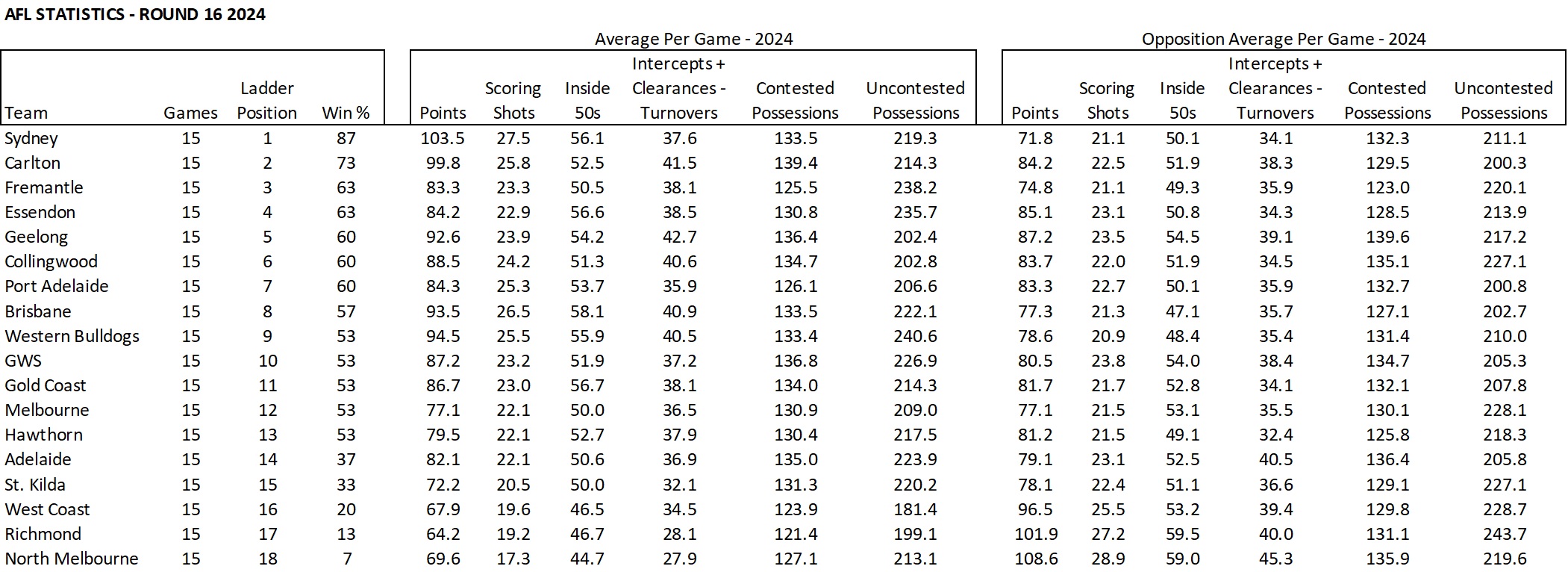
This high leaking of points stems from the Blues having trouble stopping opponents when they get the ball. Carlton has the best contested possession differential of any team this year (see table below). Yet their inside 50 differential is negative, which is highly unusual for a team sitting in second. GWS and the Bulldogs easily beat them in this area in the Blues’ two losses, and even North beat them here on the weekend. They are pretty good at stopping the ball once it gets in their back 50, but overall it means they are in the bottom half of teams in conceding scoring shots per opposition contested possession.

Teams usually do not give up points as easily as Carlton are doing and win the flag. The Blues could end up making up for this by just piling on the points themselves – after all, they just need to score more points than their opponents. It is just going to be harder for them to keep outscoring their opposition if they cannot clamp down on them a bit more.


At the conclusion of Round 17, the AFL ladder is
tight in the middle, with only two wins (and percentage) separating Carlton in
second from Hawthorn in thirteenth.
The middle of the ladder has been close all season,
and as a consequence a ‘bit of luck’ has pushed teams significantly higher or
lower than their underlying strength would suggest. The Brisbane Lions have had
one of the best inside 50 differentials this year, but had trouble converting
early in the season, and were languishing outside of the eight. Conversely, Essendon
has conceded more points than they have scored, but were still in the top four
as of last week.
Where do each of the finals contenders sit now?

The upper middle-class (top four contenders) – Despite a loss on the weekend, Carlton
should be able to secure a top four spot. The Blues are favoured in all of
their remaining matches, playing only lowly-ranked West Coast outside of
Victoria. Brisbane has it tougher, playing top-ranked team Sydney this weekend
and having to travel a couple of times. They are strong enough however that now
they have finally got themselves into the top four they should stay there.
Geelong and Fremantle are ranked a bit below those
teams, but they have both got themselves in good positions and have relatively favourable
draws. The Cats have an important match at home against the Bulldogs this week,
and the Cats and Dockers face off in a few weeks time in a match that could
determine the ‘final top four’ spot.
The bourgeois (good teams in precarious positions) – The Western Bulldogs and GWS are the
most highly rated of the other middle teams, but both are far from certainties
to make the final eight. The Dogs play Geelong and Sydney away in the next
couple of weeks, and also have a ‘deceptively tough’ away game against Adelaide
(who the rankings still consider to be above average). Given they are currently
one win out of the eight, they will likely need to snag one of those wins on
the road.
GWS have one more win than the Dogs, but also have a
tricky run home, as each week they will face off against another finals
contender. This includes an away trip to Brisbane – and most tantalisingly, a match
against the Bulldogs in Ballarat in the final round, which could determine
which of these two rivals ultimately gets a finals spot.
The lower middle-class (fighting for the last finals places) – Essendon currently have more
premiership points in the bank than the majority of finals contenders, but now
they reach a tougher part of their fixture. Matches against Adelaide, St.
Kilda, Gold Coast, and Fremantle shape as 50/50 prospects (according to the rankings),
and the Bombers have Sydney and Brisbane in their final two matches. However,
if you think the rankings currently underrate Essendon, you could be more
bullish about their chances.
The rest of the teams are fairly similar in terms of wins, ranking points, and their prospects. Hawthorn have the most favourable remaining fixture, playing the two bottom teams in their final two matches, but they are also coming from the furthest back. Gold Coast are great at home and terrible away. They have more away games left than home games, but one of those away games is against bottom side Richmond. Melbourne, Port Adelaide, and Collingwood have a mix of matches, including against each other.
Whatever way it falls, it looks like an exciting end to the season. If things fall just right, the final round this season – where among other potentially crucial games, Melbourne plays Collingwood, the Bulldogs play GWS, and Gold Coast try to finally win away against their coach’s old team – could be one for the ages.


North
Melbourne has had a wretched past few years, and up until their bye in Round 12
this year it looked like more of the same. However, since their bye, the
Kangaroos have been … average. They have won two games and lost three, but two
of those losses came by less than a goal. What are the Roos doing better?
The
Roos’ improvement has definitely come from an improved ability to win the ball …
and maybe a bit of ‘luck’. They have gone from a contested possession
differential of -15 per game up to Round 12 to +6 per game since (see table
below). In three of those past five matches, they have had a significant
advantage in clearances. But they have also benefited a little from accuracy in
front of goal; in both of their wins they had far less inside 50 entries than their
opposition, and in only one of their past five matches they have had more
scoring shots.

Over recent
weeks, the Roos have mainly managed to have their best group in the midfield –
Luke Davies-Uniacke, high draft picks Harry Sheezel and George Wardlaw, and
captain Jy Simpkin (along with ruck Tristan Xerri). They have also brought Will
Phillips back into the mix as a tagger. Sheezel had spent most of his career
until now as a defender, but as highly rated as he was as a back, he seems to
be even more valuable in the centre. He has got more than ten contested
possessions in each of his past six games – his presence down back isn’t needed
as much if the ball is less often down there!
Defensively the Roos have improved as well. They laid 87 tackles against the Eagles (+25 differential), and have been even or ahead in the tackle count in their other games since. They had generally been behind in this area for this season up to that point.
Are the Kangaroos finally on the way up? They probably will be among the bottom half of teams for a little while yet, but compared to being miles away from the rest of the competition the past month has potentially been a major step.


Rarely
has a team performed so differently at home compared with away than the Gold
Coast Suns this season. In home matches – including their two in Darwin – they are
‘the Sydney Swans’, beating opponents by an average of five goals per match (see
table below). In away matches they are ‘the Kangaroos’, losing to opponents on average
by about the same margin.

The
differences are everywhere. Their inside 50 differential is +20 better on
average at home (see table above). Their contested possessions differential is
+18 better, and their clearances +12. Their uncontested possession differential
improves from around -40 to around +40.
The
patterns are clear in their key players as well, particularly their midfield.
Noah Anderson is averaging 33 disposals and seven clearances at home this
season, and 23 disposals and four clearances away. Matt Rowell averages 26 and eight
at home, and 20 and five away. Touk Miller is averaging four more disposals at
home. Ben King averages an extra goal at home. Sam Flanders is about the same
home and away, but he has been mainly playing on the backline, watching the
ball come towards him on the road as the opposition win it out of the middle.
A fair part of this difference may come from playing harder opponents away – the Suns have played the top six ranked teams away, and the bottom four ranked teams at home. Still that seems to be only ‘half’ the story – even after adjusting for estimated home ground advantage and opponent strength, the Suns still come out as a five goal better team at home. Why? Who knows? Anderson and Rowell were not that different at home compared with away last season.
The Suns have only three of their remaining eight games left at home, but they do have a few easier games away in the remaining rounds. This could help them sneak into their first finals series. It is looking tight though, and without a major pick-up in their away performances any finals appearance may be short-lived.


A few weeks ago, I said that Hawthorn may be better than what many were giving them credit for. This was based on the Hawks having more contested possessions and similar inside 50s to their opponents but falling down in converting forward opportunities to goals. Since then, the Hawks have won six out of seven matches, and only lost their other match in the final seconds. They are fourth for ranking points over their past seven matches, behind only the three current top-ranked sides Sydney, Brisbane, and the Bulldogs, two of whom the Hawks have beaten over that period.

What the Hawks have done better over the past seven weeks is indeed better convert forward entries into goals. Their average inside 50s per game have actually fallen slightly, but they are averaging about four more scoring shots and four more goals (see table above). They are also allowing a few less inside 50s by their opponents per game. With their better conversion rate, the Hawks are now more the standard of side that could play finals, although they still face an uphill battle to make it after their slow start – even if we did rank them more in line with their recent form.
Heave-hoed
Man, did I put the mozz on Fremantle after spotlighting them last week. Their uncontested ‘keepings off’ game style got dismantled by the other team that really likes to handle the ball – the Western Bulldogs – as they were beaten by 67 points, conceded 23 goals, had 69 less uncontested possessions, and 42 less marks. They did still win the clearances though, so there’s that. I’ll take this as a delayed response to spotlighting how good the Western Bulldogs are the week before.


The
Fremantle Dockers were widely considered to be a slight disappointment last
season. They jumped from eleventh to fifth in the 2022 season with a
young team, and were expected to again play finals in 2023, but instead they
fell back to ten wins and fourteenth spot.
By the
rankings this change was more marginal – the Dockers finished a few spots
higher in 2022 than they were ranked, and dropped just over a goal’s worth in
ranking points in 2023. In 2024 up to about the season’s halfway point, it
looked like they had moved back a bit closer to their 2022 form again, although
given the closeness of teams in the middle of the ladder, not necessarily with
the same lofty result.
That
was until their 92 point demolition of Melbourne in Round 12. That has vaulted
the Dockers up to the league’s second highest percentage and third on the
rankings. Suddenly Fremantle are looking as good as any team not named the
Sydney Swans.
The
Dockers play a very noticeable high possession, uncontested game style. They
lead the league in average handballs per game, and in disposal and kicking
efficiency. Much of this happens in their backline, with Luke Ryan and Jordan
Clark being in the top ten for disposals and marks per game for defenders. This
seems to have been quite successful in preventing opposition scores, with the
Dockers having the second best rebound 50 to opposition inside 50 ratio, and conceding
the fewest points on average this season.
Fremantle is not just relying on retaining possession to get things done though, as they also have the third best contested possession differential in the league – including a massive +42 differential in their most recent win against Melbourne. In particular, the Dockers have been dominant at the stoppages, with an average clearance differential of +9. Amazingly, they almost doubled the clearances of a Demons midfield that included Max Gawn, Clayton Oliver, Christian Petracca, and Jack Viney. Caleb Serong leads the league in average clearances per game this season of players who have played more than seven games, even ahead of noted clearance ‘beasts’ Matt Rowell, Nick Daicos, Marcus Bontempelli, and Patrick Cripps.
That does however mean their ‘post-clearance’ contested possessions are slightly down, and there might be a question of how much they can rely on their ball retention under the ‘pressure cooker’ of finals. Further, the Dockers have beaten no team in the top eight – although they came close to winning three of those matches. Good signs are there for Fremantle though, and a performance like their most recent one more often than not is indicative of a team headed towards the upper end.


